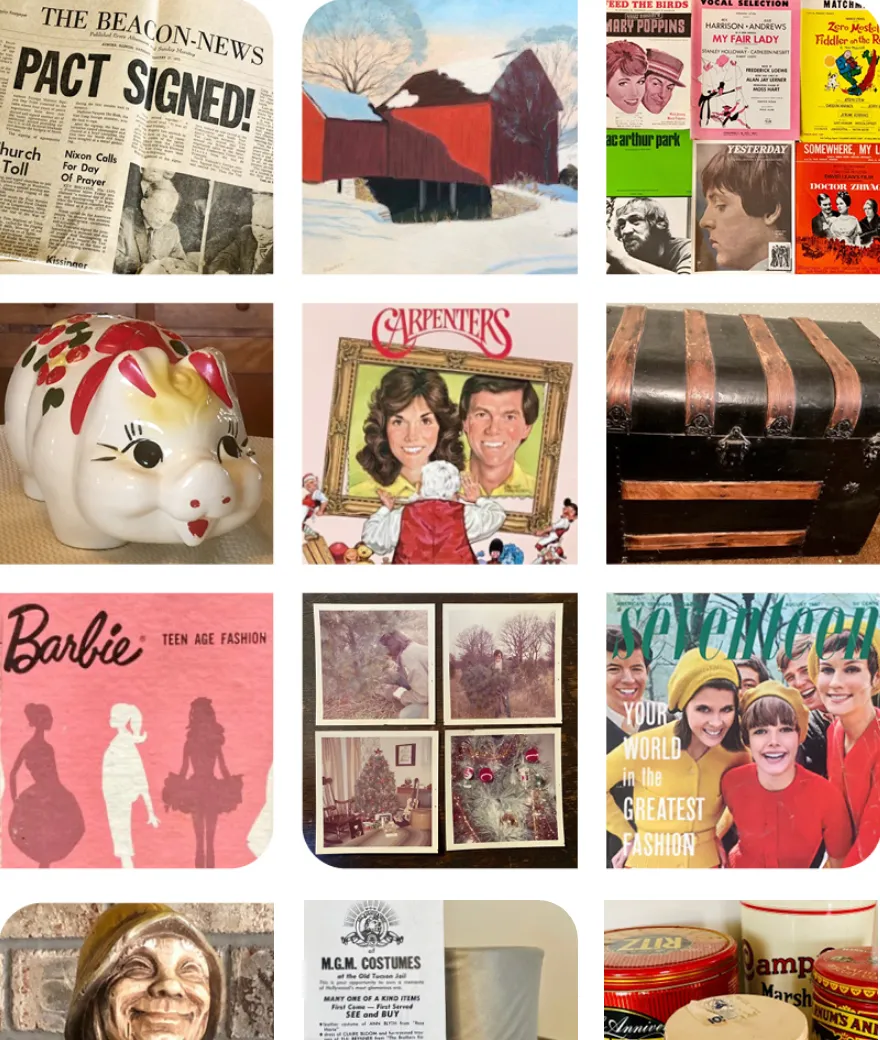

Give the gift small icon
Give the gift of Artifcts!
HELLO!
Give the gift big icon
Give the gift
of Artifcts

The perfect gift for the person
in your life who has everything.

Give a gift Close

Estate Planning of Things

Dutch Miller, CFP and Artifcts Advisory Board Member
October 22, 2025

Over the last several years, there has been a movement in technology called the “Internet of Things.” This is the growing interconnection, via the internet, of computing devices embedded in everyday objects. At some point in the future, all our home and business technology are expected to be seamless and interconnected.  

In the past, estate planning has been solely or almost completely concerned about passing a person’s assets at death. It has not been connected to other parts of life and especially not connected to the parts of all our lives that have no monetary value: family history, legacy, values, etc. If the IRS does not value it, we often ignore it in estate planning.  

If the IRS does not value it, we often ignore it in estate planning

We need to start thinking about Interconnected Estate Planning to make estate planning more wholistically connected with our lives. Especially in this age of downsizing and decluttering, we need to start thinking about how we plan to transfer our things to our children, families, and friends in a way that transfers not just the title and ownership, but also transfers the “Why” so those people and others will understand the importance and the stories behind those assets. We also can think about making those transfers during life when we have the chance to assure the best stewardship of the items for the future.  


You can watch the full episode of Evenings with Artifcts: Modern Estate Planning here.

How do we start Interconnected Estate Planning? Many of us are paralyzed or overwhelmed and do not start estate planning until late in life, or – at worst – when it is too late. Among the negative thoughts I have heard are: 

  •  “I’ll just leave this to be handled after I am gone.” 
  • “My children/grandchildren/friends/family all know what I want and they will divide everything fairly.” 
  • “I do not want to make any decisions that might make people mad after I am gone.” 
  • “I don’t want to dwell on my own death.” 

In my experience, it is much better to make a plan than to leave the disposition of your estate to chance. Many estate planning attorneys, accountants, insurance professionals, and others who help to manage assets for estates have stories of families broken apart because the person who died was not clear about disposition. There are lawsuits that have dragged on literally for decades where beneficiaries argue about these assets… and not always the most expensive items. 

 In my experience, it is much better to make a plan than to leave the disposition of your estate to chance

Fortunately, there is a solution. Creating an interconnected plan can start with considering just a few items, and without even going to an attorney. By considering these items, you have the chance to answer the most important question your beneficiaries will have after you are gone: Why? Why are these items important? Why did she save that? Why does it matter? 

In one of the episodes of Evening with Artifcts, Jeff Greenwald said, “When you are giving an object away, it motivates you to tell the story. Stories don’t take up much space at all.” So, start with a small list of items you value. Title the list “Personal Property Memorandum” and state at the start that you intend this to be included in your current or any future Will, and date it. Make the list and consider why you think those items are worth giving away, what they mean to you, name the beneficiary, and describe what the item might mean to the beneficiary.  

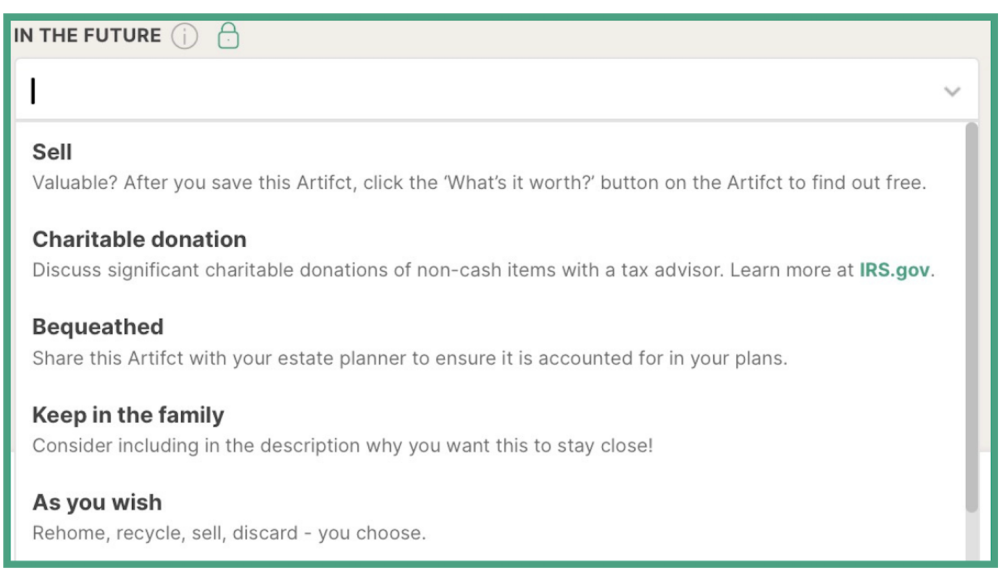
Artifcts can be a great way to start organizing your thoughts. Once you have the items in Artifcts, you could print out the items, and use the printout as part of your Memorandum. With Artifcts, you can also write directly in the "In the Future” field that the object in question is to be given to a particular person.  

By considering who should get the items, you can decide whether to wait to give it away now, or make it part of your estate. As you make these decisions, just update your Memorandum (and Artifcts!) at any time. 

This is a simple way to pass along items with the most meaning in your life to those who can most benefit. 

###

Looking for additional tips to help you tackle the estate planning of things? You might also enjoy:

Estate Planning & The Art of Artifcts

Insider's Look at What It Means to Clean Out an Estate

How Well Managed Is Your Family History Estate?

© 2025 Artifcts, Inc. All Rights Reserved.

Share With Friends
6 likes
What's New at Artifcts
The Stories We Didn't Capture | Why Preserving Family Memories Matters

When people ask me why I believe so deeply in what we're building at Artifcts, I could talk about technology. I could talk about digital preservation, AI, or the challenge of organizing a lifetime of memories. But the real answer is much simpler. 

It's my mom. 

Like so many families, as she got older, my brothers and I wanted to preserve her stories. We wanted our kids and grandkids to know not just who she was, but how she lived, what she loved, and why certain objects mattered. 

Through Artifcts, my mom documented more than 200 items, photos, and memories. She photographed treasured keepsakes, family heirlooms, travel souvenirs, and pieces of history that had found their way into our family over the decades. She told stories that otherwise would have disappeared. When she passed away, those Artifcts became one of the greatest gifts she left behind. 


As my brothers and I worked through her belongings, we didn't have to wonder what mattered most to her. We knew. We knew which objects carried special meaning, which family stories deserved to be passed along, and why she had a rather well-preserved eight-foot snakeskin on her bookcase.  

Without Artifcts, so much of that would have been guesswork. And yet...even with more than 200 Artifcts, we discovered something that surprised us. There were still chapters of her life we knew very little about. 

The Stories We Never Thought to Ask About 

Looking back through everything she created, patterns emerged. She documented many wonderful historic family items. She preserved memories from decades of travel and living overseas in such far-flung places as Kathmandu, Rio de Janeiro, and Liberia. She captured objects connected to raising a family overseas and building a life with our dad. 

However, there was remarkably little from her teenage years. Who was she before she became our mother? What were her dreams? What music did she love? What friendships shaped her? What challenges did she overcome before she ever met our father? 

Then we noticed another gap. The last twenty years of her life were barely represented. 

Without a doubt, those years mattered too. They included new friendships, changing priorities, becoming a grandmother to an ever-growing brood of grandchildren, adapting to life's inevitable changes, and countless everyday moments (hello Rummikub champion!) that become precious only after someone is gone.  

Those stories are largely lost to us now. Not because she didn't live them, but because none of us realized they still needed to be captured. We had patted ourselves on the back saying “yep, Gradnmom’s got 200 Artifcts, we’re good,” and, “we’ve heard that story a thousand times, there’s no way we’ll forget it.” Except, somehow, we have. We’ve forgotten the little details and I’m sure mixed-up others. 

Even Hundreds of Stories Leave Room for More 

One of the biggest misconceptions about preserving family history is that it's about finishing an enormous project. It's not. No one ever reaches the point where they've told every meaningful story. 

Life keeps happening. Your story changes every year. The person you are today is different from the person you were ten years ago. The memories that feel ordinary now may become the stories your grandchildren treasure most someday. 

I see this differently now than I did before losing my mom. When someone is still with us, it's easy to assume there will always be another holiday, another phone call, another chance to ask, "Tell me about when..." 

Sometimes there isn't. 

The Objects Matter—Because the Stories Matter 

People often ask whether Artifcts is really about the objects. The objects are important; they're the prompts. A cookbook becomes the story of Sunday dinners. A passport becomes decades of adventure. A baseball glove becomes a childhood friendship. A wedding ring becomes sixty years of marriage. 


Although the objects may anchor our memories, the real treasure isn't always the object itself. It's knowing why it mattered. If I could go back, I'd ask more questions. 

  • I'd ask about the years before I existed. 
  • I'd ask about the years I thought I already understood. 
  • I'd ask about the ordinary days that didn't seem remarkable at the time. 

I can't do that now, but I can encourage others to start today. Take time to document your own story. Take time to capture the stories of the people you love. 

Photograph the objects that matter. Record why they matter. Ask the questions you've been meaning to ask. Preserve the memories that seem obvious today, because one day they won't be. My one closing thought? Leave your loved ones a legacy, not a mystery.  

###

Looking for more inspiration to help you capture your stories? Check out our newest partner, MemoirGhostwriting.com, who has generously discounted their most popular memoir packages for our Artifcts members. 

You may also enjoy reading these additional ARTIcles from our Artifcts vault:

From 'Just Stuff' to Family Gold: The Power of Story

Storytelling Guide for Your Family Heirlooms

The Magic of a Guided Memoir

© 2026 Artifcts, Inc. All Rights Reserved.
Read more
New in Artifcts: Capture the Moment Now, Add the Story Later

You've probably heard the expression, "time waits for no one," and here at Artifcts we know that is true. Whether it's capturing a funny story Grandmom is sharing about her beloved candy jar, or the ten thousandth friendship bracelet woven at summer camp by your pre-teen. The stories and the objects that spark them jump in and out of our lives faster than a summer rain shower.

Sometimes we can capture them on the fly, but other times, why spoil the moment? Here at Artifcts we're excited to announce our new Drafts feature. Drafts allows you to quickly capture what matters—an audio snippet of Grandmom, or a photo of your camper and her collection of bracelets—and fill in the details whenever you're ready.

Drafts allows you to quickly capture what matters...and fill in the details whenever you're ready.

You can share a photo or video straight from your phone's gallery to your Artifcts account to start a new Artifct, or open the Artifcts App and take a photo, record a video, or capture an audio clip on the spot. We've made it easier than ever to Artifct where you're at while not losing sight of what matters most—the small moments, stories, and memories that make us smile. 

How It Works

  • Share a photo or video straight from your phone's gallery to Artifcts to start a new Artifct, or open the Artifcts App and take a photo, record a video, or capture an audio clip on the spot.
  • Add your media, tap Save, then choose Save as Draft. No title, no description, no details required.
  • Your draft appears at the top of your Artifcts list as a Local Draft, stored right on your mobile device.
  • When you're ready, open it back up, fill in the “Name Your Artifct” field and add the “Description or Story” behind it, and do a full Save to push it to the cloud and keep it safe in Artifcts. Once fully saved, you can see and edit it on the Artifcts website.

Our new Drafts feature allows you to capture the moment in seconds and tell the stories on your own time. At Artifcts, your stories matter, and we know your time is precious. Sometimes simply getting THAT photo, video, or audio snippet captured is enough motivation to go back and fill in the details later. 

Feel free to reach out to us at Hello@Artifcts.com if you have any questions or any suggestions for future features. We'd love to hear from you and we value your feedback. 

###

© 2026 Artifcts, Inc. All Rights Reserved.
Read more
If Only Our Passports Could Talk

Once upon a time, crossing an international border came with a satisfying thunk. 

An immigration officer would flip through your passport, stamp a page with ink, and send you on your way. That little mark became proof that, on a particular day, you stood in Paris, Tokyo, Buenos Aires, Cape Town, or Reykjavik. Your passport slowly transformed into a scrapbook of adventures, filled with colorful stamps, visas, and memories. 


Today, that ritual is quietly disappearing. 

As more countries adopt biometric entry systems, e-gates, and digital border processing, many travelers no longer receive passport stamps at all. Instead, passports are scanned, facial recognition verifies identity, and your arrival and departure are recorded electronically. Countries including Australia, Singapore, the United Arab Emirates, and much of Europe have increasingly embraced automated border controls. The United States also records many entries and exits digitally, and while stamps are still available in some circumstances, they're no longer the default for many travelers. 

For frequent international travelers, it can feel like the end of an era. 

The Next Generation May Never Know 

Think about handing your passport to your children or grandchildren one day. They'll flip through the pages and ask, "What are all these stamps for?" For many of them, the answer may be surprising because their own passports could remain nearly blank, despite traveling just as much—or even more—than previous generations. 

The physical evidence of travel is fading, and that's a shame, because passport stamps were never just administrative marks. They were breadcrumbs through our lives. Each one represented a moment, and every stamp held a story. Maybe it was the excitement of your first international trip; the honeymoon that started with a missed connection but ended with the best vacation of your life; or the semester abroad where strangers became lifelong friends. Whatever the story was, it was yours and yours alone; no one else would or could know the story simply by looking at the stamp. 


More Than Ink on a Page 

Open an old passport and memories come flooding back. 

That faded entry stamp from Italy reminds you of the tiny family-run restaurant where no one spoke English but somehow everyone understood one another and your daughter ended up ordering the best meal of her life. (At least according to her 15-year-old self.) The visa from India brings back the sounds, colors, and aromas that no photograph could ever fully capture. The nearly illegible stamp from Costa Rica reminds you of the rainstorm that soaked every piece of luggage before you ever reached your hotel. 

Even the imperfect moments become treasured stories over time, because if we're honest, nobody has perfect travel stories. Flights get canceled  (hello two week delay!). Luggage gets lost (and your skis rack up more air miles than you do). Or you get spectacularly lost in a city with no cell service. Those are often the stories everyone wants to hear first. 


Our Passports Have Been Quiet Historians 

Long before social media timelines and smartphone photo libraries, passports quietly documented where we had been. For genealogists and family historians alike, passport stamps provided critical "proof" of when a relative immigrated to a new home. Unlike digital photos that disappear into thousands of images on our phones, passport stamps asked almost nothing of us. They simply waited until we were ready to remember. 

The irony is that while we're documenting our lives more than ever before, some of our most meaningful physical records are disappearing. 

Ready to Get Started?  

Every passport tells a story. Instead of letting your travel memories live across photo libraries, email confirmations, Google Docs, ticket stubs, and shoeboxes of souvenirs, you can bring everything together in one place. Years from now, your passport may have only a handful of stamps—or none at all—but your travel stories can still be rich, vivid, and ready to share with family and friends. Artifcting it ensures those stories stay alive long after the ink fades.

  1. Start with the stamp
  • Create a new Artifct using a photo of a passport stamp or visa. It's the perfect starting point because it captures both the location and the date in one simple image. 
  1. Add the sights, sounds, and souvenirs
  • Bring the trip back to life by adding: A photo of yourself in the destination; videos you captured while exploring; photos of mementos you collected—artwork, ceramics, t-shirts, pins, spoons, shells, rocks, postcards, or whatever made you smile. Together, these pieces create a richer picture than any passport stamp ever could. 
  1. Include your documentation
  • Artifcts isn't just about preserving memories—it's practical, too. Add documentation such as flight confirmations and travel itineraries, hotel reservations, museum tickets and excursion bookings, or receipts, certificates of authenticity, or appraisals for valuable travel purchases that you may someday insure, include in your estate plans, or resell. Future you will be grateful. 
  1. Tell the story
  • Write five words or five thousand. Type your memories, use voice-to-text, or simply record yourself telling the story directly in the Artifcts app. There is no story burden. Capture as much—or as little—as feels right today. You can always come back and add more later. 

Travel Memories Worth Keeping 

Why Artifct your passport? Because every stamp—even the faded ones—marks a chapter of your life. Because the best stories aren't always the smooth ones. Because one day someone you love may flip through your passport and wonder what those little ink marks meant. And because memories deserve more than a fading passport page or a forgotten folder on your computer. 

Artifcting your passport makes it easy to relive your adventures, revisit trip details when planning a return visit, and share recommendations with friends heading to the same destinations. No more hunting through old emails, scattered Google Docs, or paper files to remember the name of that unforgettable hotel, hidden café, or favorite museum. 

If only our passports could talk. Thankfully, with Artifcts, they finally can. 

### 

Your passport may not capture every journey, but your stories still can. 
Start with one stamp, one souvenir, or one unforgettable trip and preserve the memories behind it in Artifcts.

Create Your First Travel Artifct Today

© 2026 Artifcts, Inc. All Rights Reserved.
Read more
Your privacy

This website uses only essential cookies to provide reliable and secure services, streamline your experience, allow you to share content from this website on social media, and to analyze how our Site is used. Learn more about these cookies and cookie settings.

Accept & Continue
Oops! This Web Browser Version is Unsupported

You received this warning because you are using an unsupported browser. Some features of Artifcts will not be available or will be displayed improperly until you update to the latest version or change browsers.

Close
Image for unsupported banner Oops! This Web Browser is Unsupported

You received this warning because you are using an unsupported browser. Some features of Artifcts will not be available or will be displayed improperly until you update to the latest version or change browsers.

Unsupported banner close icon Close