
Give the gift small icon
Give the gift of Artifcts!
HELLO!
Give the gift big icon
Give the gift
of Artifcts

The perfect gift for the person
in your life who has everything.

Give a gift Close

Artifcts & Painful Life Events Like Cancer

April 01, 2024

Reading time: 5 minutes

Life is life: A mixed bag of good and bad, amazing and terrible. We all know this and that each of these types of events shapes us. But what about these life events and your learnings from them do you want to remember and maybe even share?

In the context of cancer, we’ve walked through challenging times with some of our Arti Community members. Their life experiences have given us a window into how Artifcting can support those directly affected by cancer including the patients and the family and friends.  

Today we are sharing four examples of how Arti community members* have used Artifcting along their cancer journeys to inspire you or a loved one as you lean on Artifcts to help you through and beyond.

* Names and personal details are changed to protect the privacy of those who have shared with us.  

Margie: Decades Ago

Flower bouquets and messages of support.

When Margie joined Artifcts, she started Artifcting by going category by category through her home. One day she’d Artifct jewelry, another travel mementos, next family photographs and bibles, and so on. Artifcting quickly became a life habit. She Artifcts gifts, new to her antiques she purchases on outings with her friends, and so on.

One day back in January, while browsing through her old photos and sorting out those she wanted to Artifct the stories behind, she came across several of flower bouquets from more than a decade ago. She remembered. Each bouquet was an expression of support and sympathy as she went through treatment for breast cancer.

“I wanted to remember. It’s a wonder who shows up in these difficult moments,” said Margie.  

Bright mixed flower bouquet 


Message inside: "Thinking of you makes me think of sunny blooms."

Steve: There’s Only Today

Every pivotal life moment and framed reminder. Go!

Learning you have an inoperable tumor is a sobering moment. Everything you have dreamt for yourself for your days and years ahead is immediately vulnerable. Steve spent the first weeks of his partial diagnosis taking up Artifcting. He’d always thought Artifcts was a brilliant idea, but as years passed, he had yet to take the step to begin.

“When you realize tomorrow really might not come, priorities change.”

He Artifcted every day for weeks. He started with the present and worked backwards through time – his professional career, the lives and births of his children, his first home, university and high school days, and his own youngest years. He created all his Artifcts using photos he had easily at hand on his phone and in cloud storage. His Artifcts were brutally honest and often humorous, full of color and personality. Almost nothing he Artifcted was an item of value. 

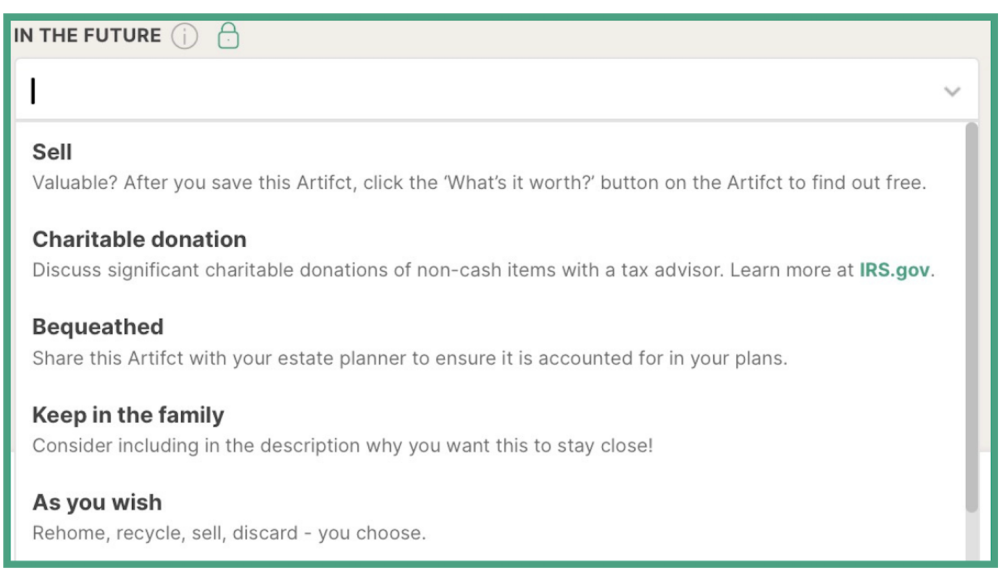
The day came when the inoperable tumor became operable, there was simply no other choice. After a successful surgery, Steve turned to Artifcting his most financially valuable items and designating his future plans for each using the “In the Future” field in each Artifct. He’d come full circle from wanting his loved ones to know HIM to wanting to take the burden off of them, letting them know what to do with all his “stuff” someday, hopefully many years from now.

Corinne: The End is Near

Personal insights and family experiences captured in photos and mementos.

It’s human nature to want to be seen and heard, known for who you are, and remembered. Corinne had lived a full life, one that included a husband, children, multiple careers, and years of travel around the world, practically no corner unexplored. Twice she had been diagnosed with cancer. Twice she had survived.

This time was different.  

Her life-long best friend, who was retired, moved in with Corinne and her husband to help provide full-time care and to spend her final weeks together. Corinne, a professional writer, had one last goal to accomplish: a memoir. But how best to rapidly sum up a life and all the insights, lessons, and more she wanted to share with her children, grandchildren, and others? 

“I had already started to Artifct. My collection started with a few trips I took and blossomed from there. Now I knew it was time to start filling in the gaps. I set up tags I wanted to use to organize chapters and themes, and I got to it. Many Artifcts didn’t have any photos of items to start. I just recorded an audio or video to set the scene for the Artifct. [My friend] helped me to take and add photos and to search my files for originals I wanted to include. I want this memoir to be more than a book. I want it to be as full of life as my life truly was and be my thanks to them all for making it so special.”  

An Artifct with photo from Kenya


When writing memoirs, more often than not, travel will make an appearance. Click the image to view an example from our co-founder Ellen.

Ellen: Lest I Forget

The ins and outs of my cancer journey.

Okay, the name on this one is not changed, this is me, co-founder of Artifcts. I didn’t create any Artifcts about my cancer in the first months after my diagnosis. I had no compulsion to immediately because I had already Artifcted everything I valued most in my home, attic to desk drawer. I didn’t know what I wanted to Artifct about my cancer itself. It was all too raw and uncertain, to be honest.

Eventually I did create Artifcts about my cancer, but only after my surgery. The first was an Artifct with flowers, gifts, and cards. It was about the objects, mostly impermanent, as much as remembering how remarkable and humbling the outpouring of support was in those hard days. And the support came from tried-and-true friends of 35+ years and brand-new friends of no more than a week or two.

My second Artifct was in essence a journal. I don’t keep a journal or a diary. But in the months when I was not Artifcting, I was keeping a Word document by date full of the details of my appointments, thoughts, and experiences. I wrote it because I knew how easily I’d forget the details and emotions as time passed. And I wanted to be able to look back and remember so that if I ever met others going through a similar experience, I’d have my own personal experience to look back on.

Three Artifcts in a row, each about cancer


These Artifcts are private, but shared with Ellen's husband and daughter.

_______________

No matter the painful life twists you’re facing, from disease to divorce to loss, we hope Artifcts can help bring you peace of mind and help you to relive and capture the moments you value most, one object, one photo, one "thing" at a time.

###

© 2024 Artifcts, Inc. All Rights Reserved.

Share With Friends
2 likes
What's New at Artifcts
What Should You Do with Old Holiday Cards?

The holidays leave behind more than sweet memories and leftover cookies—they often leave behind piles of holiday cards, envelopes, and handwritten sentiments that can accumulate year after year. Many of us have bins tucked away in closets filled with cards we think we’ll revisit someday. But what if there was a better way to preserve the heartfelt thoughts without keeping a mountain of paper?  

At Artifcts, we believe you can keep the memories and reduce the clutter creating a win-win for all. Read on to learn how to give your holiday cards a second life that actually honors the story behind them. 

Rethink What You’re Really Saving 

Holiday cards are meaningful because of the thought and connection behind them—not because of the paper they’re printed on. Most cards are never meant to be kept forever, yet many of us hang onto them like keepsakes.  

According to a recent article in the New York Post, 85 percent of Americans say they will not throw away their holiday cards this year, with the average reader claiming to have 17 cards. We get it! We like seeing our loved ones’ handwriting, and we love looking back at the old photos and re-reading the funny stories contained within. The beauty of Artifcts though is that you can capture the memory and meaning before letting go of the physical card.  

85 percent of Americans say they will not throw away their holiday cards this year...

Step-by-Step: From Card Clutter to Meaningful Memories

  1. Artifct the Best Ones 

Take a photo of your favorite holiday cards—the ones with truly personal, handwritten messages or special photos. Upload the images to Artifcts and add a story or description: who sent it, what the message meant to you, and why it stood out. You can even add audio or video too. This way, you preserve the heart of the card forever, even if the paper gets recycled later.  


One of our co-founder Heather's favorite holiday cards. Sorry, this Artifct is private!

Pro tip #1: Consider grouping cards by year or theme (e.g., “Holiday 2025”) so you can see how handwriting, designs, and messages change over time. Add a custom, private tag to the grouping so you can easily sort and search through your collection years from now. Our co-founder Heather uses a tag #frommattwithlove to quickly find the cards her husband has sent her over the years. 

Pro tip #2: Feeling overwhelmed by the number of cards? Group the photos into a single PDF and upload the PDF to Artifcts thus creating a single Artifct for all your cards this year.   

  1. Let Go Without Guilt 

Once you’ve preserved the memory with Artifcts you can recycle generic or less meaningful cards and maybe keep only a few select physical favorites if you really want. Downsizing your card collection from 17 (!) to three creates a more manageable, meaningful collection. This approach keeps holiday clutter under control while also preserving the memories, without bins and boxes taking over your home. 

It also helps you avoid the bin of forgotten cards. How many of us have that bin? And when was the last time we looked at it?  Feelings of guilt around tossing holiday cards are common but holding onto every single one can quickly become a burden rather than a joy. 

Creative Ways to Give Cards New Life 

Feeling creative? Hate the thought of simply recycling your old cards? If you enjoy repurposing things physically, here are some fun ways to reuse parts of old cards in lieu of recycling them: 

  • Cut out decorative fronts to make gift tags
  • Use images in a holiday scrapbook (with your Artifcts QR code inside!) 
  • Repurpose card pieces in crafts or family projects
  • Donate card fronts to local schools or nonprofits that reuse them  

These ideas let you enjoy the look and feel of your cards without storing them all year long AND ensuring the paper that they were printed on is kept out of a landfill.  

Make It a Holiday Habit 

In case you missed last week's ARTIcle, it should come as no surprise that we're all about habits here at Artifcts. Next time you finish celebrating (be it a birthday or a holiday), take a moment to Artifct your favorite cards. In a short time, you’ll have a beautiful digital collection of holiday love that you can revisit and share anytime with family, inspire future generations, or simply enjoy reflecting on year after year.  

###

Old cards, photos, and letters on your mind? You might also enjoy these related ARTIcles:

What Should You Do with Old Scrapbooks?

Rescue Mission! That's More Than a Photo

How to Artifct Cards & Letters

© 2026 Artifcts, Inc. All Rights Reserved.
Read more
At Artifcts We’re Talking #HabitChange in the New Year

As we kick off a brand new year, it’s the perfect moment to reflect on how small shifts in our routines can create lasting change. With 2026 underway, many of us are thinking not just about resolutions, but about building habits that genuinely stick and bring more meaning to our everyday lives.

Changing habits isn’t easy — especially when it comes to creating new ways of preserving memories, stories, and the things that matter most. Whether you’re looking to be more intentional about documenting family histories, organizing meaningful items, or simply wanting to make sure important moments aren’t lost, we're here to help.

At Artifcts, we're big fans of the book, Atomic Habits by James Clear, it's a must read in our view because it speaks to all of us no matter our day-to-day way of living. 

For example, are you the type of person for whom the moment an item is added to your to-do list you ignore it as though it were written in invisible ink? Or do you sweat that list out until it's done, hopefully as soon as possible, and then cross it off your list with great satisfaction? 

Yup, James Clear sees us all and has strategies to help. 

In case you haven't read, or have no interest in reading, his book, we've developed some practical strategies and insights to help you turn #HabitChange into lasting practices, and make 2026 the year you preserve what matters most in ways that are simple, sustainable, and personally meaningful. 

Read on for tips that will help you shape routines that support your goals — from starting new habits to keeping them — and bring purpose and clarity to how you care for the memories and items you treasure.

Three Habit Strategies for our Artifcts Community 

STRATEGY ONE 

Like everything else in life, to create new habits, you need to consider first what “rewards” you want from, in this case, Artifcting. Depending on your situation, maybe you identify with one of these, and it will help guide you to the right habit-based approach to Artifcting and what you do with your Artifct once you create it: 

  • I need to be better organized and in greater control of the ‘stuff’ around me. Consider our 5 Ways to Start Artifcting, room by room, most valuable, most cherished, that closet you hate to open … 
  • I want to make sure my loved one is not forgotten. Artifcting need not be a solo experience. Create an invite-only circle to share and remember those who you have lost. 
  • I want to document and share my family history. Invite-only circles on Artifcts are one place to start so that you can invite family in to see heirlooms, but social media groups are often another great source of information, and you can easily share your Artifcts into social media for more fact and family lore gathering. 
  • I love swapping good stories, laughing and remembering with friends and family. So try sharing an Artifct or two and see how that works for you; add audio or video too so your loved ones can hear your story in your voice.  

STRATEGY TWO 

Frame Artifcting as a "when" activity so it becomes intentional. The key here is to be very specific! 

  • "Every Sunday when my husband watches the football game, I'll grab my phone and create two new Artifcts." 
  • "When I add something into storage, I'll Artifct it first."
  • “When I buy something over $100, I will ask myself, “Is this an Artifct?” and Artifct it on the spot (with receipt!) and fill in the full details later. 
  • "When I unpack my suitcase, I'll Artifct my new mementos along with the photos from the trip." 
  • "Every Friday when my son brings his art folder home, I’ll Artifct his projects with him while he has an after-school snack.” 

STRATEGY THREE 

Try out what Clear calls "habit stacking" to incorporate Artifcting into your regular routines and existing habits. 

  • "Each season when I organize my closet, I'll Artifct any sentimental pieces, and then sort the items into three piles: keep, consignment, or donation." 
  • "As I review my estate plan each year, I will check that my Artifcts are included in the tangible assets memorandum."
  • “As I add an item to my daughter's baby keepsakes box, I will Artifct it. Then I will put the box away immediately.” 
  • "While we put away the holiday decorations each winter, we will take breaks. During the breaks we’ll Artifct special ornaments, cards, etc.” 

The best way to build a new habit is to start small — and start now. Create one Artifct. See how easy it is. No pressure, no perfection required — just one story, one moment, one memory captured.

From there, build a rhythm that works for you, on your schedule. One Artifct a week adds up faster than you might expect. By the end of the year, you’ll have 52 Artifcts, 52 stories, and 52 memories preserved — a meaningful collection of what matters most.

This is how preservation becomes a habit — not a task. Begin today by creating your first Artifct. Happy Artifcting!

###

© 2026 Artifcts, Inc. All Rights Reserved. 
Any mistakes in the interpretation of the habits to Artifcting belong to Artifcts. In fact, we would encourage you to download the free habit cheat sheets from the author at atomichabits.com/cheatsheet

Read more
Looking Back with Gratitude, Looking Ahead with Purpose

Dear Artifcts Members, 

As we step into a brand-new year, I want to pause and say thank you. Artifcts exists because of you—your stories, your trust, and your belief that the memories behind our things matter just as much as the things themselves. As we reflect on 2025, I’m filled with gratitude and pride for what we’ve built together. 

This past year was one of meaningful growth and exciting milestones. We partnered with Clutter Cleaner to help families facing downsizing and life transitions preserve what truly matters—the stories and significance behind their belongings. This collaboration reinforced our shared belief that letting go of things doesn’t mean letting go of memories. 

We were also honored to be named one of Family Tree Magazine’s Top Genealogy Tech Websites for the third year in a row. This recognition reflects our continued commitment to supporting families, historians, and everyday memory-keepers with thoughtful, accessible technology. 

In 2025, I also had the opportunity to join the Northern Trust “Secrets of Enterprising Families” podcast, where we talked openly about legacy, loss, and practical estate planning. These conversations are at the heart of why Artifcts exists—to make space for reflection, clarity, and connection across generations. 

On the product side, we reached a major milestone with the launch of ARTIAssist, our first AI-backed feature. ARTIAssist was designed to make creating Artifcts easier and more intuitive, helping members capture historical and factual details behind their most cherished keepsakes. This was a big step forward for us, and we’re just getting started. 

None of this would be possible without your continued support, feedback, and enthusiasm. You inspire us every day. 

Looking ahead to 2026, we’re excited about what’s to come: 

  • Continued refinement of ARTIAssist and other AI-powered tools to help you create new Artifcts with confidence and ease 
  • Virtual workshops designed to help you get the most out of every Artifcts feature 
  • And a growing team, bringing new ideas, energy, and expertise to better serve our community 

Thank you for being part of the Artifcts family and for trusting us with your stories. Here’s to a new year filled with reflection, discovery, and connection—and to preserving what matters most, together. 

With gratitude and warm wishes for the year ahead, 


Co-Founder & CEO, Artifcts 
Happy New Year ✨ 

Read more
Your privacy

This website uses only essential cookies to provide reliable and secure services, streamline your experience, allow you to share content from this website on social media, and to analyze how our Site is used. Learn more about these cookies and cookie settings.

Accept & Continue
Oops! This Web Browser Version is Unsupported

You received this warning because you are using an unsupported browser. Some features of Artifcts will not be available or will be displayed improperly until you update to the latest version or change browsers.

Close
Image for unsupported banner Oops! This Web Browser is Unsupported

You received this warning because you are using an unsupported browser. Some features of Artifcts will not be available or will be displayed improperly until you update to the latest version or change browsers.

Unsupported banner close icon Close