



Give the gift small icon
Give the gift of Artifcts!
HELLO!
Give the gift big icon
Give the gift
of Artifcts

The perfect gift for the person
in your life who has everything.

Give a gift Close
Exclusive articles, interviews, and insights covering downsizing & decluttering, genealogy, photos and other media, aging well, travel, and more. We’re here to help you capture the big little moments and stories to bring meaning and order to all of life’s collections and memories for generations.
Share With Friends
The Gift of Being Prepared

August is National Make a Will Month—a timely reminder to pause and make sure the people and things we care about will be taken care of when we can no longer do it ourselves. 

Here at Artifcts, we’re all about preparing for life’s what-ifs. Some are joyful: What if we move into our dream home? What if the kids grow up and start families of their own? What if we downsize and discover a simpler way of living? Others are harder to contemplate: What if something happens to me? 

Planning for that possibility isn’t morbid. It’s an act of love.  

The ultimate gift you can give your family isn’t necessarily something they can unwrap. It’s the gift of being prepared so that when they are grieving, they aren’t also left to navigate a lifetime of paperwork, possessions, keepsakes, questions, and decisions without knowing what you would have wanted. 

A Will Is a Beginning, Not the Full Story 

When we think about estate planning, we tend to think about the big things: the house, investments, retirement accounts, life insurance, and other financial assets. 

And yes, those things matter. A will or broader estate plan provides an essential framework for what happens to your assets and who is responsible for carrying out your wishes. 

But what about everything else? 

The jewelry in the dresser, the artwork on the walls, the tools in the garage, and the family photographs. Or maybe it’s the collection you spent decades building, your wedding china, or your handwritten recipe cards. What about the odd little object sitting on your mantle that looks completely ordinary to everyone else but holds a story only you know? 

Traditional estate planning can be very good at answering what goes where. It doesn't always capture why something matters. As former Artifcts Advisory Board Member and CFP Dutch Miller has written, estate planning has historically focused on assets that have monetary value while overlooking the family history, legacy, and values attached to the things that may have little or no financial value

That’s where the real work of being prepared begins. 

Don't Leave Your Family Guessing 

Imagine your family opening the door to your home after you're gone. They are already grieving. Now they have to figure out what to do with everything you left behind. 

Which pieces of furniture mattered to you? Who should get the jewelry? Is that painting valuable—or simply sentimental? Why did you keep those letters? Who in the family would appreciate the old camera? Should they sell, donate, keep, or give away the things filling the house? 

And perhaps most importantly: What would you have wanted? Without some guidance, your family has to guess. 

We’ve seen firsthand how overwhelming that can be. The transfer of a lifetime of “stuff” can become an emotional and logistical burden for the people left behind. Not everything will have monetary value. Not everything will be wanted. And not every object needs to make its way into the next generation. But the things that do matter deserve to be identified, understood, and intentionally passed along.  
That’s why being prepared is about more than having a will. It’s about giving your loved ones a roadmap. 

Be Prepared with Artifcts 

At Artifcts, we’ve long talked about the importance of gifting your loved ones a why. 

Knowing that Grandma left you a particular piece of jewelry is one thing. Knowing that she wore it on her wedding day, that her mother gave it to her, and that she hoped you would wear it someday is something entirely different. 

The story changes the object. It creates connections, preserves memories, and can even reduce conflict. And it helps your loved ones understand why a seemingly ordinary thing was important to you.  

You don't have to leave your family a perfectly curated museum of your life. You simply need to make some choices while you can. 

You don't have to leave your family a perfectly curated museum of your life. You simply need to make some choices while you can...

This August, as you review your will or estate plan, take a second look around your home. 

What do you want to: 

  • Bequeath to a specific person?
  • Keep in the family for future generations?
  • Donate to a person or organization?
  • Sell because it has financial value?
  • Pass along to someone who will truly appreciate it?
  • Let go of because it no longer serves a purpose? 

The choice is yours, but please, we beg you, make the choice. 

And for the things you choose to pass along, consider documenting the story behind them on our Artifcts App. A photograph, a few sentences, a video, an audio recording, a certificate of authenticity, an appraisal, or simply your own voice explaining why something matters can make an enormous difference later. 

With Artifcts, you can create a digital record of the things that matter to you, capture their stories and supporting documentation, and use the “In the Future” field to provide guidance about what should happen to an item when the time comes—keep, donate, sell, bequeath, or “as you wish.”  Think of it as creating a roadmap for the tangible pieces of your life. 

The Ultimate Gift Isn't More Stuff 

We often think of an inheritance as a gift. But what happens when an inheritance becomes a house full of decisions? 

As families navigate the Great Stuff Transfer, more and more people are discovering that inheriting a lifetime of possessions can be stressful, expensive, and emotionally complicated. The most meaningful inheritance isn't necessarily the largest one. It's the one that comes with context, intention, and understanding. 

Your children may not want everything you own. That's okay. Your grandchildren may not know the monetary value of an object. That's okay, too. 

What they may want—and what they may desperately need when you're gone—is to know what mattered to you, what you hoped would happen to the things you loved, and the stories that made your life yours. 

So, this month, give your family a gift they won't have to open for years. Give them the gift of being prepared. Take time to review your will or estate plan. Make sure it reflects your life and wishes today—not five, ten, or twenty years ago. 

Don't have a will or estate plan? Contact a local attorney or estate planner to help you get started. You can also explore our partner, and fellow AARP AgeTech Collaborative company Trust & Will, which offers online estate planning solutions.  

And don't forget your tangible assets. Walk through your home. Open the drawers. Look in the attic, basement, garage, and storage unit. Think about the objects that tell your story. Then start documenting them in Artifcts. 

Bequeath. Donate. Sell. Keep it in the family. Let it go. The choice is yours. Just don't leave your family guessing, because the greatest gift you can give the people you love isn't a house full of things to sort through or a binder full of paperwork to decipher. It's clarity. It's intention. It's the comfort of knowing what you wanted—and why. 

That's the gift of being prepared. 

###

© 2026 Artifcts, Inc. All Rights Reserved.
 

Read more
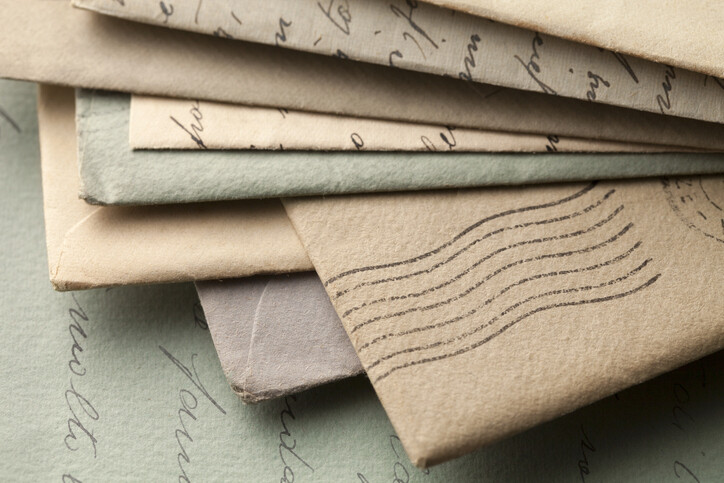
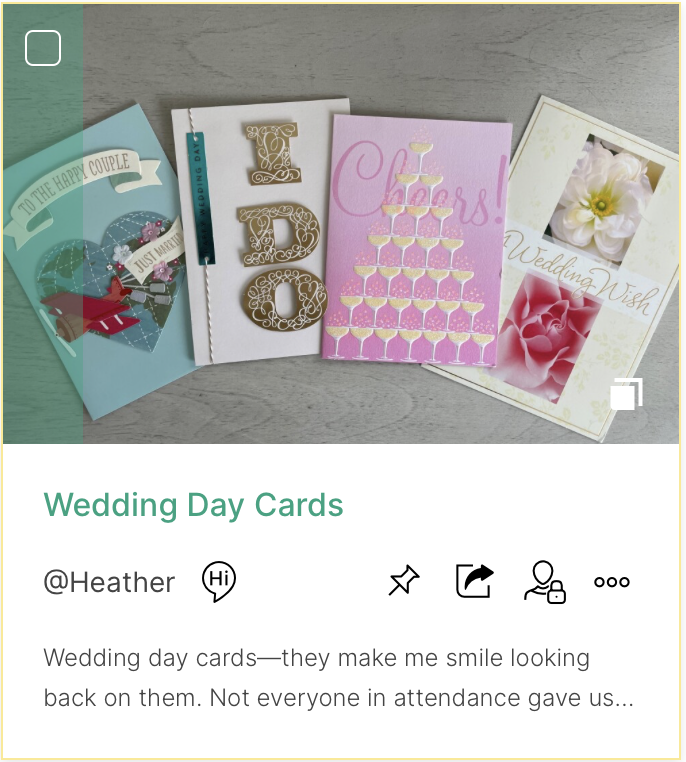
What Should You Do with Old Cards and Letters?

At Artifcts, we've seen this question come up again and again—and we understand why. 

Today, there are more than 150 publicly Artifcted cards and letters on Artifcts.com, each preserving a story, a relationship, or a moment in time. Our Co-Founder, Heather, has also privately Artifcted more than three dozen cards and letters from her own life (and still has a couple dozen more to go!). 

We hear you, and you are not alone. Cards and letters are sneaky. They don't take up much space individually, but together they can fill boxes, bins, closets, and entire storage shelves. Unlike many other possessions, they're full of sentiment, emotion, and something increasingly rare, handwriting. We want to keep them because they connect us to people and moments that mattered. 


But then life happens. The bins overflow. The storage area fills up. Years pass, sometimes decades. And despite keeping every birthday card, holiday greeting, love note, sympathy card, or handwritten letter, we rarely pull them out to read them again.  

So...what should you do with them? 

Start with a Different Question 

Instead of asking, "Should I keep this card?" ask yourself: 

"What am I really trying to preserve?" 

Most of the time, it's not the paper itself. It's your grandmother's unmistakable cursive. It's the note your child scribbled before they learned to spell. It's the anniversary card that reminds you exactly how you felt in that moment in time. It's the laugh-out-loud birthday card from a friend who always knew how to make you smile. 


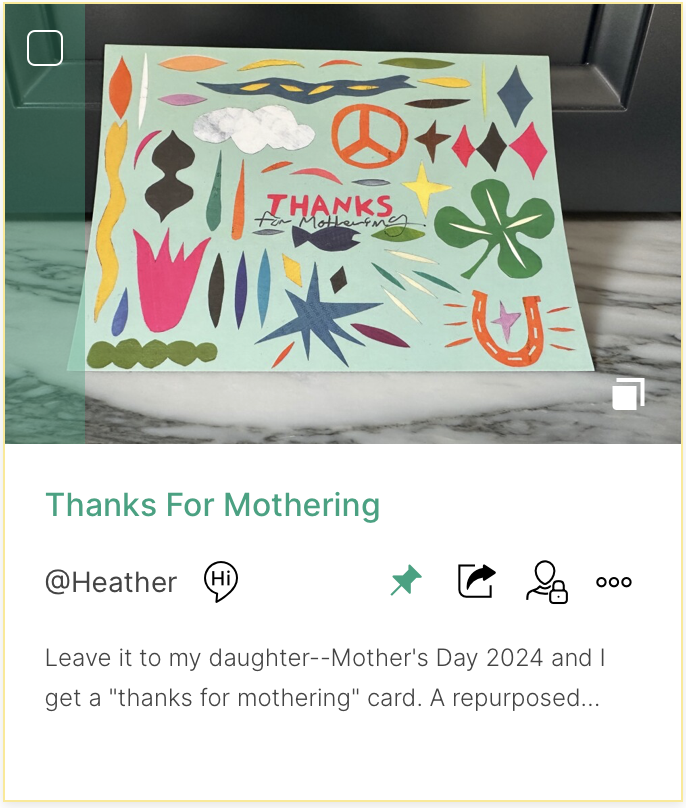
Laugh-out-loud and always makes me smile. Mother's Day 2024. Sorry, this Artifct is private!

Often, the physical card is simply the vessel that carries the memory forward, lest we forget. 

You Don't Have to Keep Every Piece of Paper 

Many people feel guilty even considering letting go of cards and letters. It can feel like discarding the relationship itself. But preserving memories doesn't have to mean storing every card, letter, note, or envelope forever. 

As you sort through your collection, consider categories like: 

  • Cards that mark major life milestones.
  • Letters from people who have shaped your life.
  • Notes that tell a meaningful story.
  • Cards with especially memorable handwriting or artwork.
  • Messages that still make you smile, laugh, or cry. 

These are often the pieces worth preserving—not because they're old, but because they continue to have meaning and someday someone else in your family may be curious enough to want to see them or even keep them as part of their family history too. 

Preserve the Memory, Reduce the Clutter 

Whether you're downsizing, helping parents organize decades of keepsakes, or simply reclaiming space at home, preserving the stories first makes it much easier to decide what to do with the physical items afterward. By photographing or scanning meaningful cards and letters and pairing them with your own memories, you create an archive that's easier to revisit than a stack of bins tucked away in the attic. 

Here's an easy way to get started: 

  1. Choose the cards and letters that matter most. Start with a small group—perhaps birthday cards from your parents, letters from a grandparent, love notes, or cards that commemorate major milestones.
  2. Photograph or scan each piece. Capture the front, inside message, back, and envelope if it adds context. Don't worry about perfection; your goal is to preserve the memory.
  3. Add the images to an Artifct and tell the story behind them. Who wrote it? What was happening in your life? Why has this particular note stayed with you all these years? Those details transform a simple card into part of your personal history. 

Once you've preserved both the images and the story, you'll find it much easier to decide whether the physical card belongs in a keepsake box, should be passed on to family, or can finally be recycled.  

Less Clutter. More Memories. 

Cards and letters were never meant to spend decades hidden in storage bins. They were written to be read, remembered, and cherished. That's exactly what Artifcts helps you do. 

Artifct your cards and letters to create a fully accessible, shareable archive of the notes, sweet sentiments, heartfelt messages, and laugh-out-loud moments that matter most. Add the stories behind them, preserve the handwriting, and revisit them anytime, from anywhere. 

Because the goal isn't to keep every piece of paper. It's to keep the memories. Happy Artifcting!

###

Looking for additional tips on how to Artifct cards, letters, and other ephemera? Check out our How to Artifcts Cards & Letters article to help you get started. 

© 2026 Artifcts, Inc. All Rights Reserved.
Read more
The Stories We Didn't Capture | Why Preserving Family Memories Matters

When people ask me why I believe so deeply in what we're building at Artifcts, I could talk about technology. I could talk about digital preservation, AI, or the challenge of organizing a lifetime of memories. But the real answer is much simpler. 

It's my mom. 

Like so many families, as she got older, my brothers and I wanted to preserve her stories. We wanted our kids and grandkids to know not just who she was, but how she lived, what she loved, and why certain objects mattered. 

Through Artifcts, my mom documented more than 200 items, photos, and memories. She photographed treasured keepsakes, family heirlooms, travel souvenirs, and pieces of history that had found their way into our family over the decades. She told stories that otherwise would have disappeared. When she passed away, those Artifcts became one of the greatest gifts she left behind. 


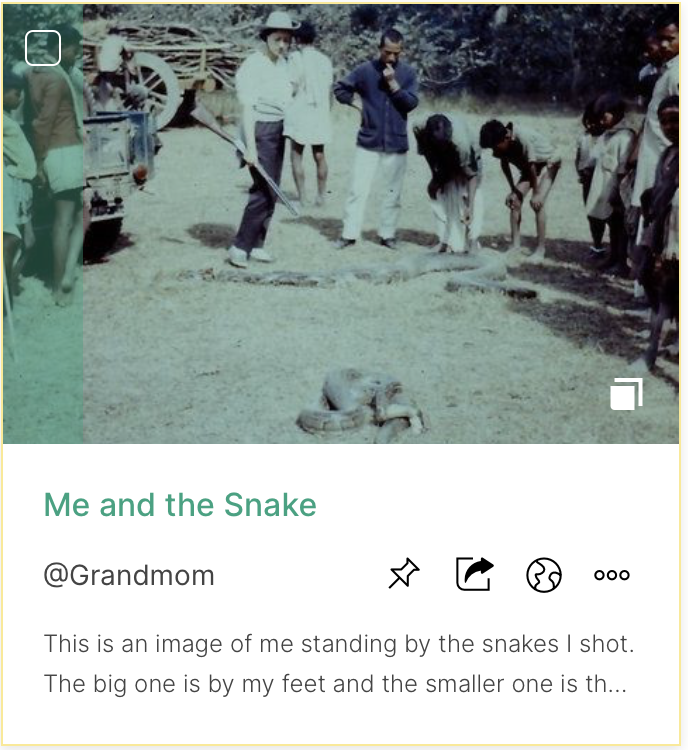
As my brothers and I worked through her belongings, we didn't have to wonder what mattered most to her. We knew. We knew which objects carried special meaning, which family stories deserved to be passed along, and why she had a rather well-preserved eight-foot snakeskin on her bookcase.  

Without Artifcts, so much of that would have been guesswork. And yet...even with more than 200 Artifcts, we discovered something that surprised us. There were still chapters of her life we knew very little about. 

The Stories We Never Thought to Ask About 

Looking back through everything she created, patterns emerged. She documented many wonderful historic family items. She preserved memories from decades of travel and living overseas in such far-flung places as Kathmandu, Rio de Janeiro, and Liberia. She captured objects connected to raising a family overseas and building a life with our dad. 

However, there was remarkably little from her teenage years. Who was she before she became our mother? What were her dreams? What music did she love? What friendships shaped her? What challenges did she overcome before she ever met our father? 

Then we noticed another gap. The last twenty years of her life were barely represented. 

Without a doubt, those years mattered too. They included new friendships, changing priorities, becoming a grandmother to an ever-growing brood of grandchildren, adapting to life's inevitable changes, and countless everyday moments (hello Rummikub champion!) that become precious only after someone is gone.  

Those stories are largely lost to us now. Not because she didn't live them, but because none of us realized they still needed to be captured. We had patted ourselves on the back saying “yep, Gradnmom’s got 200 Artifcts, we’re good,” and, “we’ve heard that story a thousand times, there’s no way we’ll forget it.” Except, somehow, we have. We’ve forgotten the little details and I’m sure mixed-up others. 

Even Hundreds of Stories Leave Room for More 

One of the biggest misconceptions about preserving family history is that it's about finishing an enormous project. It's not. No one ever reaches the point where they've told every meaningful story. 

Life keeps happening. Your story changes every year. The person you are today is different from the person you were ten years ago. The memories that feel ordinary now may become the stories your grandchildren treasure most someday. 

I see this differently now than I did before losing my mom. When someone is still with us, it's easy to assume there will always be another holiday, another phone call, another chance to ask, "Tell me about when..." 

Sometimes there isn't. 

The Objects Matter—Because the Stories Matter 

People often ask whether Artifcts is really about the objects. The objects are important; they're the prompts. A cookbook becomes the story of Sunday dinners. A passport becomes decades of adventure. A baseball glove becomes a childhood friendship. A wedding ring becomes sixty years of marriage. 


Although the objects may anchor our memories, the real treasure isn't always the object itself. It's knowing why it mattered. If I could go back, I'd ask more questions. 

  • I'd ask about the years before I existed. 
  • I'd ask about the years I thought I already understood. 
  • I'd ask about the ordinary days that didn't seem remarkable at the time. 

I can't do that now, but I can encourage others to start today. Take time to document your own story. Take time to capture the stories of the people you love. 

Photograph the objects that matter. Record why they matter. Ask the questions you've been meaning to ask. Preserve the memories that seem obvious today, because one day they won't be. My one closing thought? Leave your loved ones a legacy, not a mystery.  

###

Looking for more inspiration to help you capture your stories? Check out our newest partner, MemoirGhostwriting.com, who has generously discounted their most popular memoir packages for our Artifcts members. 

You may also enjoy reading these additional ARTIcles from our Artifcts vault:

From 'Just Stuff' to Family Gold: The Power of Story

Storytelling Guide for Your Family Heirlooms

The Magic of a Guided Memoir

© 2026 Artifcts, Inc. All Rights Reserved.
Read more
New in Artifcts: Capture the Moment Now, Add the Story Later

You've probably heard the expression, "time waits for no one," and here at Artifcts we know that is true. Whether it's capturing a funny story Grandmom is sharing about her beloved candy jar, or the ten thousandth friendship bracelet woven at summer camp by your pre-teen. The stories and the objects that spark them jump in and out of our lives faster than a summer rain shower.

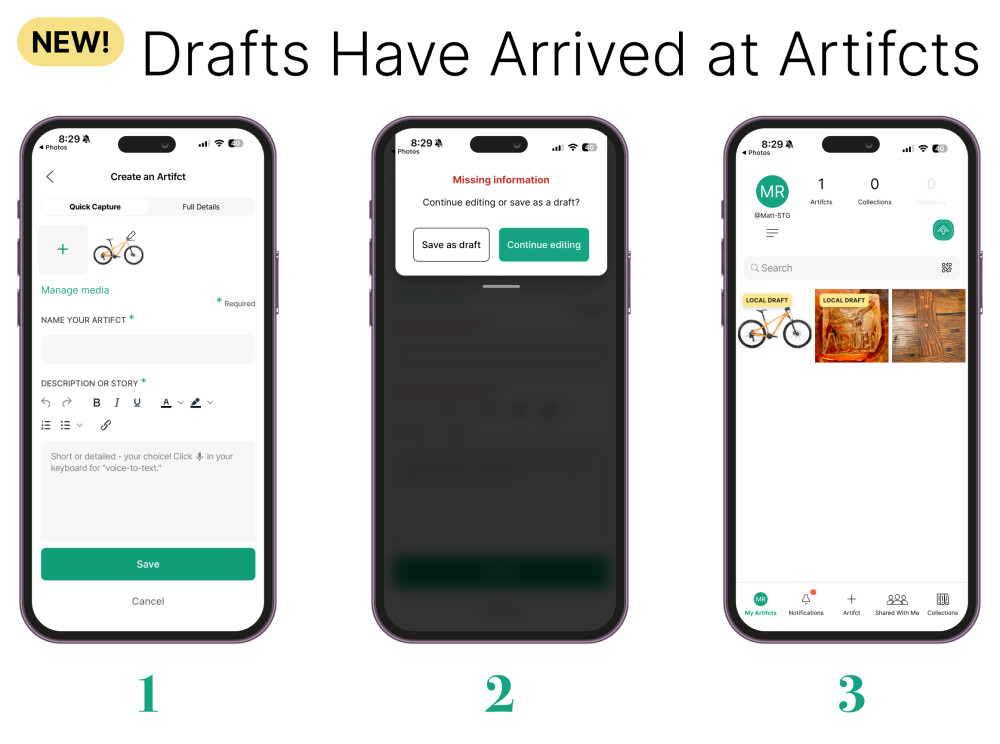
Sometimes we can capture them on the fly, but other times, why spoil the moment? Here at Artifcts we're excited to announce our new Drafts feature. Drafts allows you to quickly capture what matters—an audio snippet of Grandmom, or a photo of your camper and her collection of bracelets—and fill in the details whenever you're ready.

Drafts allows you to quickly capture what matters...and fill in the details whenever you're ready.

You can share a photo or video straight from your phone's gallery to your Artifcts account to start a new Artifct, or open the Artifcts App and take a photo, record a video, or capture an audio clip on the spot. We've made it easier than ever to Artifct where you're at while not losing sight of what matters most—the small moments, stories, and memories that make us smile. 

How It Works

  • Share a photo or video straight from your phone's gallery to Artifcts to start a new Artifct, or open the Artifcts App and take a photo, record a video, or capture an audio clip on the spot.
  • Add your media, tap Save, then choose Save as Draft. No title, no description, no details required.
  • Your draft appears at the top of your Artifcts list as a Local Draft, stored right on your mobile device.
  • When you're ready, open it back up, fill in the “Name Your Artifct” field and add the “Description or Story” behind it, and do a full Save to push it to the cloud and keep it safe in Artifcts. Once fully saved, you can see and edit it on the Artifcts website.

Our new Drafts feature allows you to capture the moment in seconds and tell the stories on your own time. At Artifcts, your stories matter, and we know your time is precious. Sometimes simply getting THAT photo, video, or audio snippet captured is enough motivation to go back and fill in the details later. 

Feel free to reach out to us at Hello@Artifcts.com if you have any questions or any suggestions for future features. We'd love to hear from you and we value your feedback. 

###

© 2026 Artifcts, Inc. All Rights Reserved.
Read more
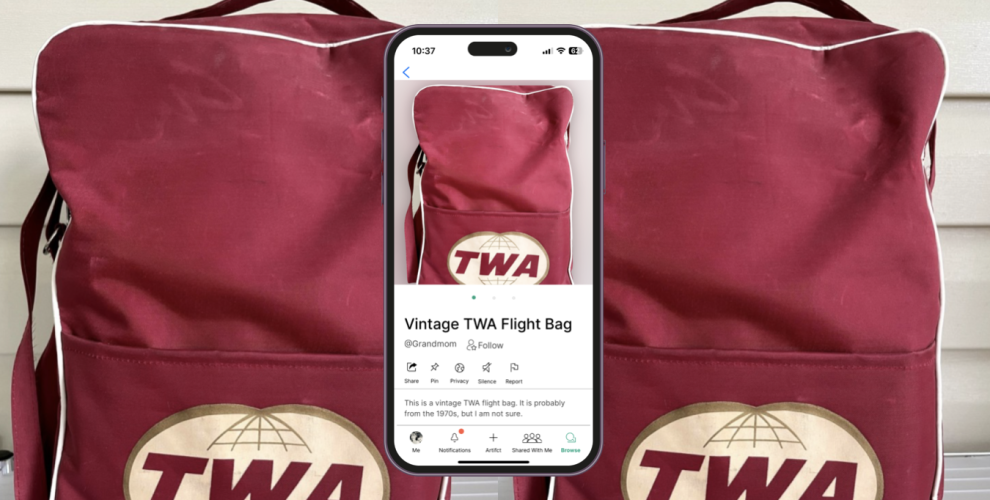
If Only Our Passports Could Talk

Once upon a time, crossing an international border came with a satisfying thunk. 

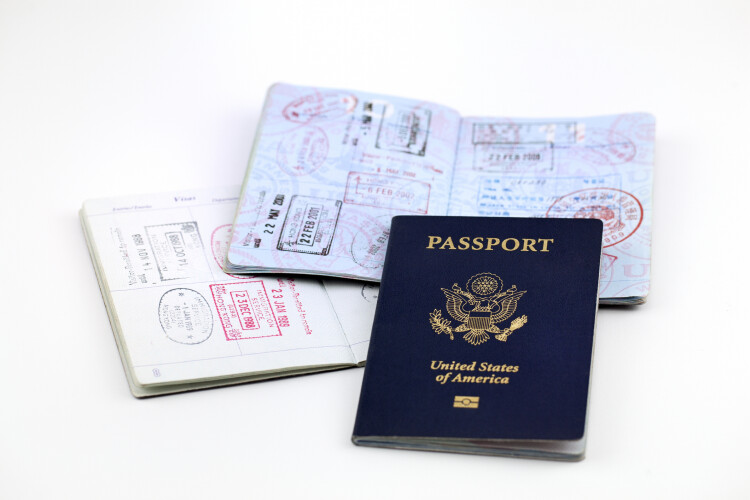
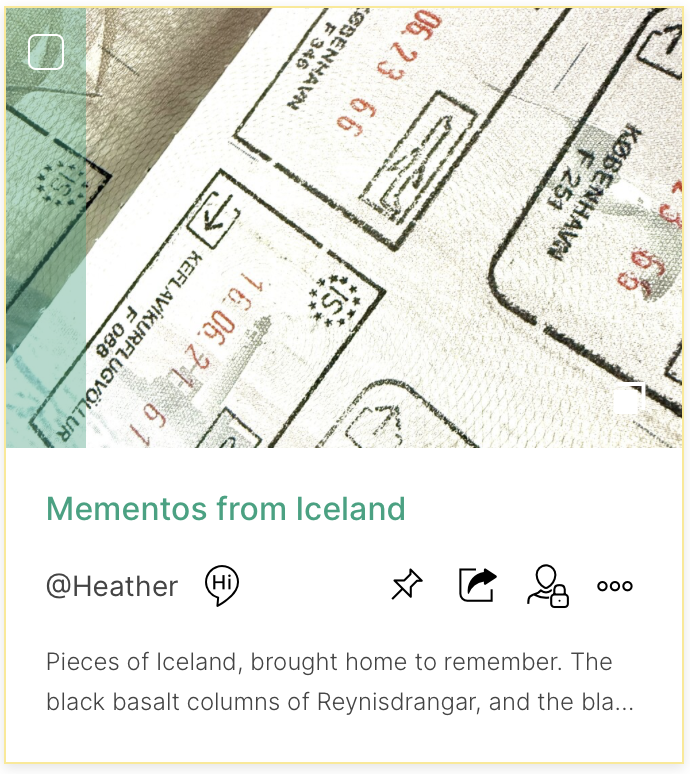
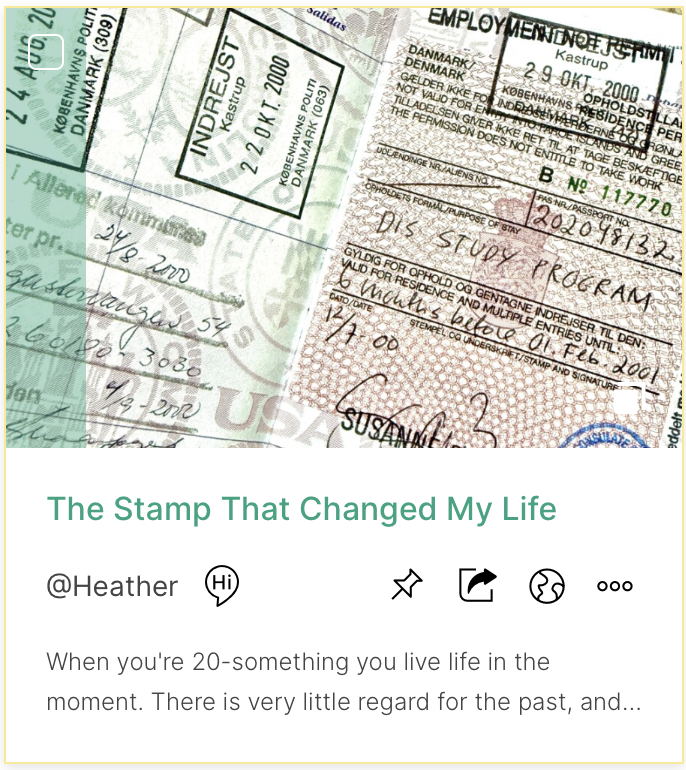
An immigration officer would flip through your passport, stamp a page with ink, and send you on your way. That little mark became proof that, on a particular day, you stood in Paris, Tokyo, Buenos Aires, Cape Town, or Reykjavik. Your passport slowly transformed into a scrapbook of adventures, filled with colorful stamps, visas, and memories. 


Today, that ritual is quietly disappearing. 

As more countries adopt biometric entry systems, e-gates, and digital border processing, many travelers no longer receive passport stamps at all. Instead, passports are scanned, facial recognition verifies identity, and your arrival and departure are recorded electronically. Countries including Australia, Singapore, the United Arab Emirates, and much of Europe have increasingly embraced automated border controls. The United States also records many entries and exits digitally, and while stamps are still available in some circumstances, they're no longer the default for many travelers. 

For frequent international travelers, it can feel like the end of an era. 

The Next Generation May Never Know 

Think about handing your passport to your children or grandchildren one day. They'll flip through the pages and ask, "What are all these stamps for?" For many of them, the answer may be surprising because their own passports could remain nearly blank, despite traveling just as much—or even more—than previous generations. 

The physical evidence of travel is fading, and that's a shame, because passport stamps were never just administrative marks. They were breadcrumbs through our lives. Each one represented a moment, and every stamp held a story. Maybe it was the excitement of your first international trip; the honeymoon that started with a missed connection but ended with the best vacation of your life; or the semester abroad where strangers became lifelong friends. Whatever the story was, it was yours and yours alone; no one else would or could know the story simply by looking at the stamp. 


More Than Ink on a Page 

Open an old passport and memories come flooding back. 

That faded entry stamp from Italy reminds you of the tiny family-run restaurant where no one spoke English but somehow everyone understood one another and your daughter ended up ordering the best meal of her life. (At least according to her 15-year-old self.) The visa from India brings back the sounds, colors, and aromas that no photograph could ever fully capture. The nearly illegible stamp from Costa Rica reminds you of the rainstorm that soaked every piece of luggage before you ever reached your hotel. 

Even the imperfect moments become treasured stories over time, because if we're honest, nobody has perfect travel stories. Flights get canceled  (hello two week delay!). Luggage gets lost (and your skis rack up more air miles than you do). Or you get spectacularly lost in a city with no cell service. Those are often the stories everyone wants to hear first. 


Our Passports Have Been Quiet Historians 

Long before social media timelines and smartphone photo libraries, passports quietly documented where we had been. For genealogists and family historians alike, passport stamps provided critical "proof" of when a relative immigrated to a new home. Unlike digital photos that disappear into thousands of images on our phones, passport stamps asked almost nothing of us. They simply waited until we were ready to remember. 

The irony is that while we're documenting our lives more than ever before, some of our most meaningful physical records are disappearing. 

Ready to Get Started?  

Every passport tells a story. Instead of letting your travel memories live across photo libraries, email confirmations, Google Docs, ticket stubs, and shoeboxes of souvenirs, you can bring everything together in one place. Years from now, your passport may have only a handful of stamps—or none at all—but your travel stories can still be rich, vivid, and ready to share with family and friends. Artifcting it ensures those stories stay alive long after the ink fades.

  1. Start with the stamp
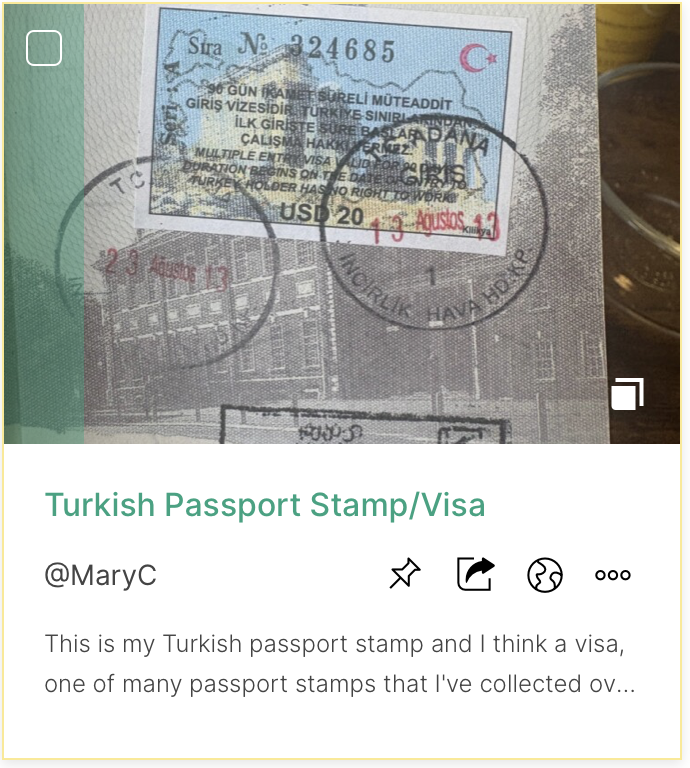
  • Create a new Artifct using a photo of a passport stamp or visa. It's the perfect starting point because it captures both the location and the date in one simple image. 
  1. Add the sights, sounds, and souvenirs
  • Bring the trip back to life by adding: A photo of yourself in the destination; videos you captured while exploring; photos of mementos you collected—artwork, ceramics, t-shirts, pins, spoons, shells, rocks, postcards, or whatever made you smile. Together, these pieces create a richer picture than any passport stamp ever could. 
  1. Include your documentation
  • Artifcts isn't just about preserving memories—it's practical, too. Add documentation such as flight confirmations and travel itineraries, hotel reservations, museum tickets and excursion bookings, or receipts, certificates of authenticity, or appraisals for valuable travel purchases that you may someday insure, include in your estate plans, or resell. Future you will be grateful. 
  1. Tell the story
  • Write five words or five thousand. Type your memories, use voice-to-text, or simply record yourself telling the story directly in the Artifcts app. There is no story burden. Capture as much—or as little—as feels right today. You can always come back and add more later. 

Travel Memories Worth Keeping 

Why Artifct your passport? Because every stamp—even the faded ones—marks a chapter of your life. Because the best stories aren't always the smooth ones. Because one day someone you love may flip through your passport and wonder what those little ink marks meant. And because memories deserve more than a fading passport page or a forgotten folder on your computer. 

Artifcting your passport makes it easy to relive your adventures, revisit trip details when planning a return visit, and share recommendations with friends heading to the same destinations. No more hunting through old emails, scattered Google Docs, or paper files to remember the name of that unforgettable hotel, hidden café, or favorite museum. 

If only our passports could talk. Thankfully, with Artifcts, they finally can. 

### 

Your passport may not capture every journey, but your stories still can. 
Start with one stamp, one souvenir, or one unforgettable trip and preserve the memories behind it in Artifcts.

Create Your First Travel Artifct Today

© 2026 Artifcts, Inc. All Rights Reserved.
Read more
The Magic of a Guided Memoir: Turning a Lifetime of Stories into a Lasting Legacy

We often don’t realize how many of our questions remain unanswered until someone we love is no longer there to answer them. A family tree might tell us where someone was born, and a photograph might show us what they looked like. But those records can’t answer our questions about the life-changing decisions they made, their fears as new parents, or ordinary family moments that made them laugh.

That’s where thoughtful conversation can make all the difference.

We recently sat down with Luke Palder, founder and CEO of our partner MemoirGhostwriting.com, a company that helps people preserve their memories, family history, and life experiences through guided interviews. Its team transforms those conversations into a cohesive written keepsake that reflects the storyteller’s own voice and can be shared with future generations.

Luke shared why ordinary lives are never ordinary, why so many people postpone telling their stories, and how the right questions can uncover the moments families will value most.

“Ordinary” Lives: Why Every Story Matters

A memoir captures the stories that matter most for the people who matter most. When discussing memoir projects, Luke commonly hears two objections:

  • “My life isn’t that interesting.”
  • “No one will ever read it.”

When a 93-year-old woman wondered what there could possibly be to include in her memoir, she explained that she had only taught kindergarten for two years and raised five children.

Luke’s response was simple: “No one has raised five kids and doesn’t have fascinating stories.”

A meaningful life doesn’t require fame or widely lauded achievements. Ordinary experiences often become extraordinary with time.

As Luke explained: “The goal is not to have lots of people read it. It’s to have the people who matter most to you read it.”

One useful question can put the value of the project into perspective: Would you want the same gift from your own grandparents or great-grandparents?

And a memoir doesn’t have to focus on every job, relationship, and milestone. Instead, it can focus on the experiences that best reveal someone’s character, relationships, humor, values, and way of seeing the world.

As Luke put it: “A memoir allows you to put your thumb on the scale of what’s important.”

That freedom allows the storyteller to move quickly through some periods while lingering over the memories that carry the greatest meaning.

MemoirGhostwriting.com helps uncover the kinds of stories people often overlook at first, such as adjusting to life in a new country, a parent building a treehouse, or the objects someone keeps on a desk or beside the bed. Sometimes the memory of building a treehouse reveals more about a parent than the technical details of the job they held for 30 years.

Objects can be especially powerful entry points into those memories. A stuffed animal, piece of china, photograph, recipe, or keepsake may unlock an entire chapter of someone’s life.

At Artifcts, we see this every day. The object may begin the conversation, but the memories and meaning surrounding it are what make the story worth preserving.

Why So Many Life Stories Remain Unfinished

Luke shared three common barriers that can make telling a life story or completing a memoir feel overwhelming.

  1. People don’t know what “finished” looks like

Most people create a memoir only once, so they begin without a clear sense of its appropriate length, scope, or destination. As Luke explained: “It’s hard to know what done looks like.” A guided process establishes what the finished memoir is intended to become before the storyteller is asked to account for an entire lifetime.

  1. They begin without an outline

Luke compared writing a memoir without an outline to building a house without blueprints. Tangents can sometimes uncover an unexpected story, but more often they make it difficult to stay focused and reach a finished result. A thoughtful structure gives the storyteller direction while still leaving room for memories to surface naturally.

  1. Finishing carries emotional weight

Completing a memoir can feel like seeing the shape of an entire life laid out on the page. That can be deeply meaningful, but it can also feel intimidating. This is where the human side of the process matters. MemoirGhostwriting.com’s interviewers serve as organizers and guides, helping storytellers move forward at a comfortable pace. Just as importantly, they build a relationship rooted in trust, so people feel supported rather than pressured.

Many people postpone preserving their stories because they assume there will be more time. But health, memory, and circumstances can change unexpectedly. Luke’s advice was simple: “Whether it’s with us or somebody else, record something.”

That might mean beginning a professional memoir, recording a conversation around the kitchen table using our Artifcts App, or asking one question while a loved one can still respond in their own voice. Don’t wait for the perfect time or the perfect system. Begin with what is possible today.

The Power of a Thoughtful Conversation

Written prompts can help, but a guided conversation often uncovers stories someone may never think to record on their own. A skilled interviewer notices when a memory sparks emotion and knows when to ask a follow-up question.

Luke described watching for a small but meaningful signal: “You see this little glint in their eye and… there’s something there that I’m going to circle back to.”

Photographs and meaningful objects can help unlock those memories, too. The goal is to create a trusting space where stories can surface naturally, then shape those memories into a memoir that still sounds and feels like the storyteller.

A Memoir Doesn’t Have to Be a Full-Length Book

MemoirGhostwriting.com offers a range of packages based on factors such as the storyteller’s goals, budget, and desired finished product:

  • Transcript-focused keepsakes that preserve and organize the storyteller’s words
  • “Mini” memoirs or life overviews centered on key moments or chapters
  • Fully ghostwritten memoirs shaped into a polished, narrative-style book
  • Customized projects that may include photographs, maps, recipes, family trees, or existing written materials

Luke emphasized that the most extensive option is not always the best one. The right memoir is the one that fits the family’s purpose, whether that means creating an accessible record for loved ones or a more fully developed book with a literary arc. The company’s client-focused process is also designed to make memoir production easy and fun.

The right memoir is the one that fits the family’s purpose...

What the Memoir-Making Process Looks Like

MemoirGhostwriting.com breaks the project into manageable steps while adapting it to each storyteller’s needs.

  • Initial consultation: Luke and the storyteller discuss the purpose of the memoir and the desired scope.
  • Recorded interviews: A skilled interviewer leads structured conversations while leaving room for unexpected memories and stories to emerge naturally. Photographs, family trees, existing writing, records, and meaningful objects can all help guide the questions.
  • Transcription and writing: The interviews are transcribed and, depending on the package selected, organized into an outline that’s fleshed out into a manuscript.
  • Review and revisions: The storyteller reviews the outline, first draft, and edited and proofread drafts throughout the process, ensuring the finished work reflects their voice, memories, and intentions.
  • Design and delivery: The final project typically includes printed books and digital files, including the interview recordings.

The process is fully customizable. The team can provide large-print drafts, mail paper copies for review, or help families photograph meaningful items, making it easier for each storyteller to participate comfortably.

The Life Story and the Stories Behind the Things

A memoir preserves the larger arc of a person’s life, while Artifcts captures the individual objects, photographs, and keepsakes that help bring that life into focus.

Together, they offer two different views of the same story:

  • An Artifct preserves the meaning behind a particular object.
  • A memoir connects those moments into a broader life narrative.
  • Existing Artifcts can help identify important people, places, traditions, and memories to explore during interviews.
  • A memoir can add context that connects individual objects and stories across generations.

Luke shared that photographs and meaningful objects are often some of the best tools for bringing forgotten memories to the surface. A recipe, piece of jewelry, childhood toy, or family photograph can lead to a story that may never have emerged through dates and timelines alone.

The important thing is not to wait until everything has been perfectly organized or documented. Start with a few meaningful objects, a few photographs, or one important memory, and let the story grow from there.

Ready to preserve more of your family’s story?

Start by documenting one meaningful object in Artifcts, then explore how MemoirGhostwriting.com can help bring a lifetime of memories together through guided interviews and a finished family memoir.

###

© 2026 Artifcts, Inc. All Rights Reserved.

Read more
How to Prepare for a Move Without Losing Your Mind (Or Your Child’s Lovey)

Our co-founder Heather is getting ready for her fourth move in five years. At this point, you'd think she'd have moving down to a science. 

Spoiler alert, she doesn't. 

The thing is, even if you've moved multiple times, no one prepares you for the inevitable chaos. The boxes all start out neatly taped and labeled. Then somehow, hours later you find yourself surrounded by a sea of cardboard, balled up packing tape, and a child on the verge of a meltdown screaming "Mom, where's Shimmering Star?" For the record, Shimmering Star is the stuffed bunny you repeatedly reminded said child NOT to pack in a box and instead carry in their day pack.  

Bonus points if your spouse simultaneously chimes in with, "Honey, where'd you put the coffee maker?" while the dog is desperately looking your way with his patented, please-tell-me-you-remembered-my-kibble-mom look.  

Moving has a remarkable way of making even the most organized person question every life choice that led to accumulating so much...stuff. 

The good news? While you can't eliminate every "Where's the XYZ?" moment, you can make the entire process dramatically easier by getting organized before you pack your first box. 

It's tempting to start packing as soon as you know you're moving, but taking the time to declutter and organize first will save you time, money, and stress. Even better, it's the perfect opportunity to preserve the stories and details behind the belongings that matter most with Artifcts. 

Step 1: Declutter Before You Pack 

Why pay to move things you no longer need, use, or love? 

Every box you eliminate means less to pack, less to transport, less to unpack, and less to find a home for in your new space. Decluttering before a move also gives you a fresh start, allowing your new home to reflect your current lifestyle—not years of accumulated "just in case" items. 

If you're wondering where to begin, consider tackling items like: 

  • Duplicate kitchen gadgets and cookware
  • Clothing that no longer fits or hasn't been worn in years
  • Expired pantry items and medications
  • Old paperwork and manuals that can be securely shredded or recycled
  • Broken electronics and tangled cords
  • Outgrown toys and games
  • Decorative items that no longer match your style
  • Boxes of forgotten keepsakes you've been storing "for someday" 

Our article, 108 Objects to Declutter from Your Home, offers even more ideas to help you make meaningful progress room by room.  

As you sort, remember that decluttering doesn't have to mean losing the memories attached to your belongings. If you want to keep the memory of those keepsakes while maybe not the actual items, take a moment to snap a photo and create a quick Artifct in our App. You can always go back and add the details later.   


Step 2: Organize What You're Keeping and Artifct Before You Move 

Once you've decided what deserves a place in your next home, resist the urge to immediately start boxing everything up. This is the ideal time to organize and Artifct your most meaningful possessions. 

Think about family heirlooms, artwork, collections, antiques, military memorabilia, jewelry, childhood keepsakes, vintage toys, furniture, and other objects that tell the story of your life and your family. Heather also likes to Artifct anything that is or has the potential to be breakable, which with a 75-pound golden retriever underfoot is quite a long list! 

Before those items disappear into moving boxes, take a few minutes to: 

  • Photograph each item.
  • Record its story, history, and significance.
  • Note its current condition.
  • Attach any appraisals, receipts, or insurance information. 

Not only are you preserving memories, you're also creating a digital record that can be invaluable later. 

No matter how careful your movers are, accidents happen. Boxes get crushed. Furniture gets scratched. Artwork can be damaged. Sometimes items are even lost. 

When you've already created an Artifct, you have: 

  • Photos showing the item's pre-move condition.
  • Documentation of identifying features and provenance.
  • Purchase information or appraisals when available.
  • A centralized place to store supporting documents. 

This information can make insurance claims much easier should something unfortunate occur during the move. 


Our co-founder Heather Artifcts anything breakable before a move as life always has a way of happening...

And for the items that simply can't be replaced—a grandmother's quilt, a handwritten recipe book, a child's first artwork, or your grandfather's military medals—you'll always have their stories preserved, regardless of what happens to the physical object. 

After you've decluttered, organized, and Artifcted what matters most, packing becomes far more intentional. You'll know exactly what you're moving and which items require extra care. Instead of simply moving boxes, you're moving the pieces of your life with confidence—and protecting both the objects and the stories they carry. 

Let Go Without Losing the Story 

One of the hardest parts of moving or downsizing is deciding what to part with. Matt Paxton, author, television personality, and longtime advocate for helping families through life's transitions, beautifully captures why Artifcts changes that experience: 

"Take a picture, tell the story in Artifcts, and you can donate it away. The story lives on, and the memory lives on, and the person lives on. You don't need the item to do that." 

When the memories are preserved, letting go of the physical object often becomes much easier. Families can confidently donate treasured belongings, knowing the stories behind them remain accessible for future generations. 

Make Your Next Move Your Most Organized One Yet 

Moving is more than changing addresses. It's an opportunity to decide what deserves space in your next chapter. 

With Artifcts, you're not just preparing for moving day. You're protecting your memories, simplifying insurance documentation, making downsizing easier, and ensuring that the stories behind your most treasured belongings live on for generations to come. 

###

Looking for more ideas on how to Artifct during or after a move? One of our Artifcts community members, who grew up in a military family, shared that they Artifct the house they are moving from prior to the move so that they will always be able to remember what the house (and rooms!) looked like. We love this idea! Sometimes Artifcting those big items (like a house, car, etc.) may not seem obvious at first, but they are just as important as the small items we tend to Artifct most.

© 2026 Artifcts, Inc. All Rights Reserved.

Read more
Travel Without All the 'Stuff'

The Dalai Lama may have put it best, “Once a year, go somewhere you have never been before.” To some, that may be trekking halfway across the world; to others, it may be a day trip one town over to try out a new restaurant or hike a new trail. Travel need not be far flung to be enriching and rewarding. 

Here at Artifcts, our team members are avid world travelers and adventurers. We are also big fans of carry-on only travel and being able to pick up and go as plans change. This often means that space is at a premium, and not all desired souvenirs make the cut for the return trip home. Our children know this too well, as often the first question asked before making a purchase abroad is, “Do you have room for it in your backpack?” Notice we said backpack, not suitcase.  

In the outdoors world, there is a concept (and organization) called "Leave No Trace" which calls on travelers to be conscious of the effects their actions may have on plants, animals, other people, and entire ecosystems. There are seven principles that guide and inform leave no trace, and include: 

      • Plan ahead and prepare
      • Travel and camp on durable surfaces
      • Dispose of waste properly
      • Leave what you find
      • Minimize campfire impacts
      • Respect wildlife
      • Be considerate of other visitors 

We’d like to be so bold as to add an eighth to the list: Artifct where you’re at.  

We know firsthand that the memories and sun tans will fade, and that the little details that seemed so crystal-clear months ago will one day be a jumbled mess. Our co-founder Heather discovered that neither she nor her husband could recall all the hikes they did on their honeymoon in Italy; thankfully for them, they had saved their hikes in AllTrails and were able to recently piece together Artifcts from their honeymoon seven years ago, combining photos and videos from the hikes, the AllTrails maps, and their favorite memories and stories from the trip. 

We have also seen how souvenirs, once home and put on a shelf or tucked away in a drawer, are often forgotten or fall victim to time, breaking, crumbling, or fading. How many of us are living with those “please-mom-this-is-all-I-want" travel mementos that are no longer remotely interesting to said child?   

We have also found ourselves traveling in places that don’t always lend themselves to souvenir shopping. Several summers ago, Heather ventured off to Greenland for a week-long hiking adventure. Much to her delight, she did not encounter a single souvenir shop during her time in the Greenlandic wilderness.  

Ready to Give Leave No Trace Artifcting A Try?

Leave No Trace Artifcting is a simple and fun way to relive those much-loved travel adventures, while also saving space, money, and lessening your environmental footprint. Want to give it a try? We’ve put together these four easy tips to get started:  

      1. Pick an object. It could be Arctic flora you’ve never seen before, a favorite sunset, or even an interesting sign or mural discovered exploring a new city. 
      2. Take a photo and add video or audio, too. Trail maps, video snippets, even museum signs, all make for great add-ons.   
      3. Add a short story. You can always add more when you get home (or when you're inevitably stuck at the airport waiting for your flight that was supposed to depart hours ago).
      4. Save and you’re done! Want to share the love and memories? Privately share with family and friends or create a Circle to share near and far. Add a custom tag or two to quickly find the Artifcts from your favorite trips.  

 
Intrigued and want to try #leavenotrace Artifcting but worried about depriving the local economy of much-needed tourism dollars? One of our Artifcts Community members shared with us what they do—they Artifct on the go, and then when they get home (sans a suitcase full of souvenirs) they donate to a local charity they discovered while traveling. It sounds like a win-win to us! 

As you head out on your next adventure, or relive recent summer journeys, pause, and ‘Artifct that’ souvenir, memento, or memory from your trip. Your future self will never regret taking a moment to tell the story behind THAT photo, THAT t-shirt, or THAT travel treasure. 

___________________

Check out other Travel related ARTIcles by Artifcts:

Artifcts + Travel Go Better Together

Preserving Your Best Travel Memories

Have Passport. Willing to Travel

###

© 2026 Artifcts, Inc. All Rights Reserved.

Read more
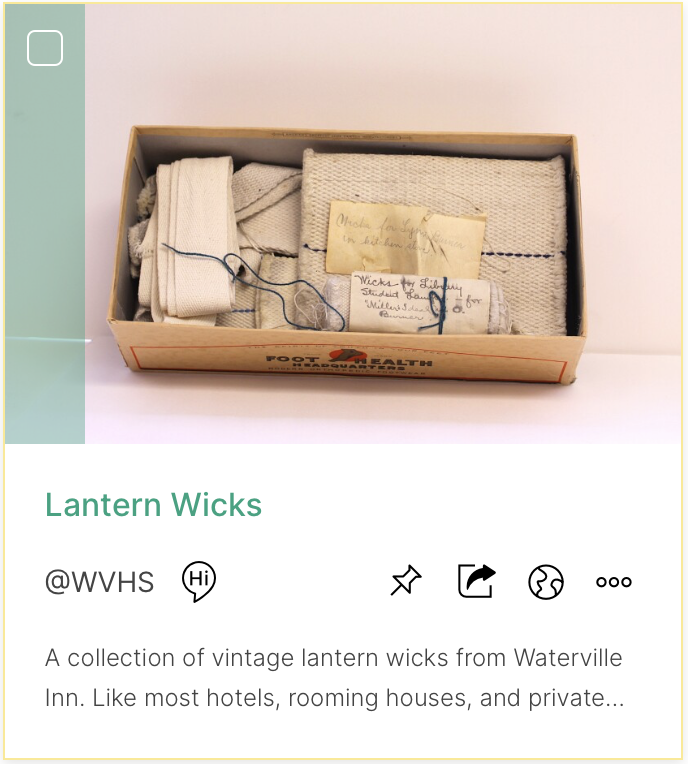
Preserving Waterville Valley's History, One Artifct at a Time

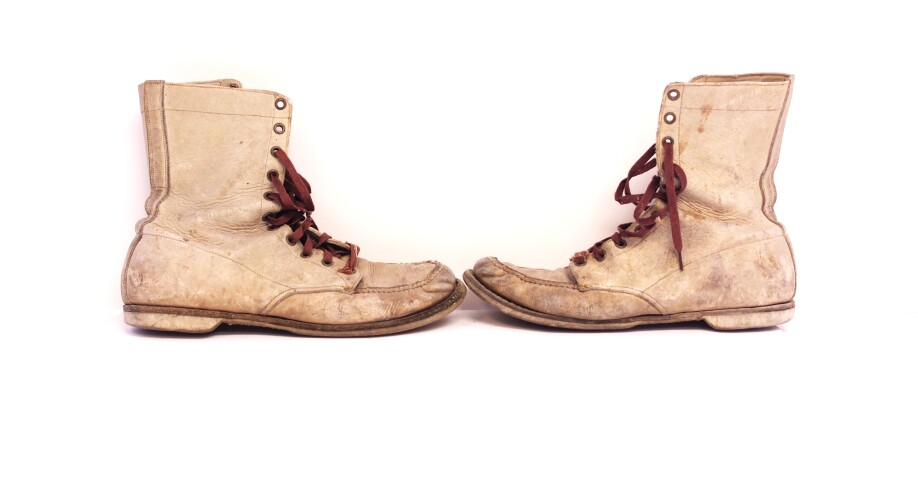
At Artifcts, we often say that every object has a story. Whether it's a family heirloom, a piece of artwork, a treasured photograph, or a well-worn pair of hiking boots, the real value lies not only in the item itself but in the memories, people, and history connected to it. 

That's why we're especially excited about our partnership with the Waterville Valley Historical Society, an organization dedicated to preserving and sharing the rich history of one of New Hampshire's most beloved mountain communities. 

A Shared Mission of Preservation 

When members of the Waterville Valley Historical Society (WVHS) first learned about Artifcts, they immediately recognized the potential of the platform to help make their collection more accessible to the community. Historical societies often serve as stewards of remarkable local stories, but finding ways to organize, document, and share those stories in engaging and sustainable ways can be challenging. 

Artifcts offers a different approach—one that preserves not just artifacts, but the stories behind them. As Patty Furgal, President of WVHS said, "Sharing items from the Historical Society's collection with Artifcts was so much easier and faster than attempts at sharing them via adding images and descriptions directly to our website. No technical expertise in website design or graphic design is needed."

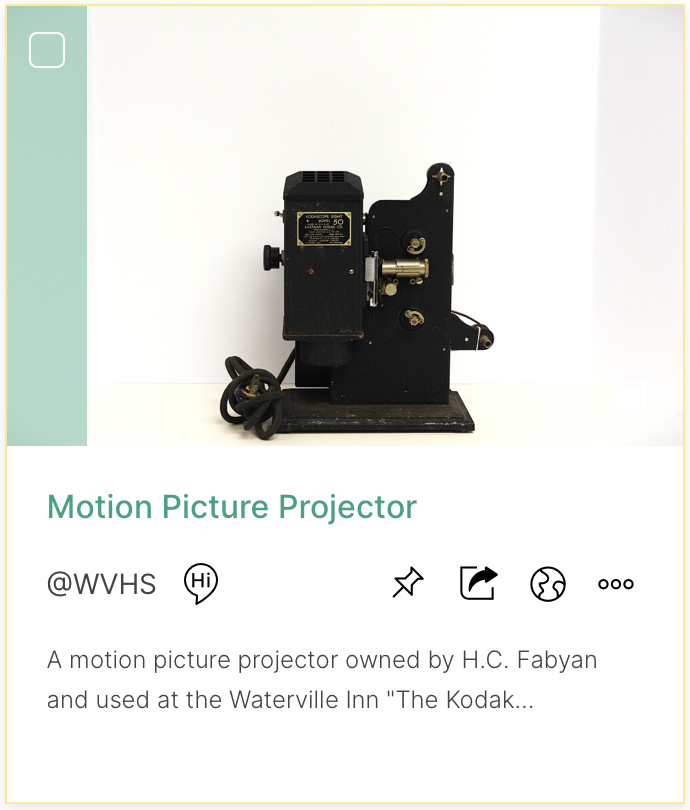
By creating digital records that combine photographs, historical details, family memories, and contextual information, Artifcts helps ensure that important pieces of history remain connected to the narratives that give them meaning. Furgal also added, "We can easily create different online ‘exhibits’ using simple tags," such as #WatervilleValley or #FabyanLorenzAdamsCollection

Bringing Local History to Life 

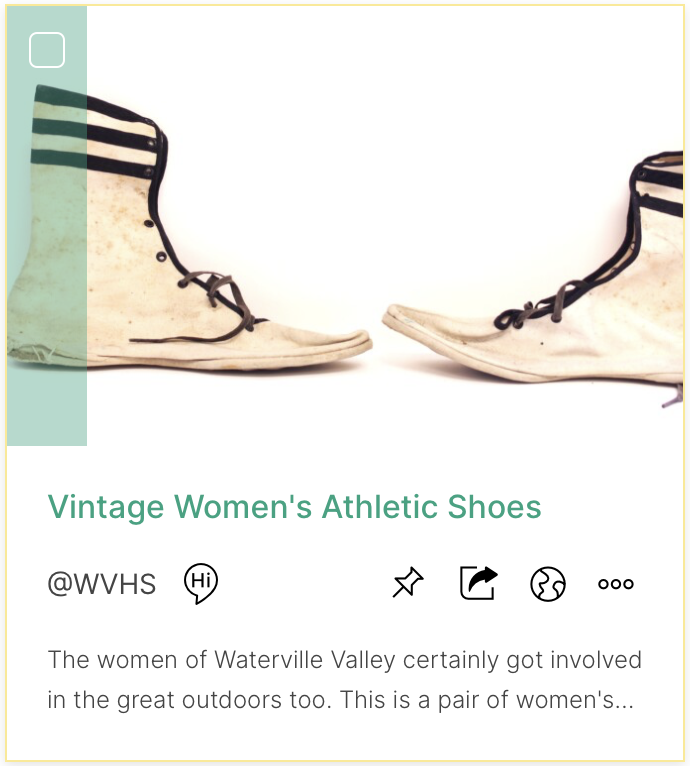
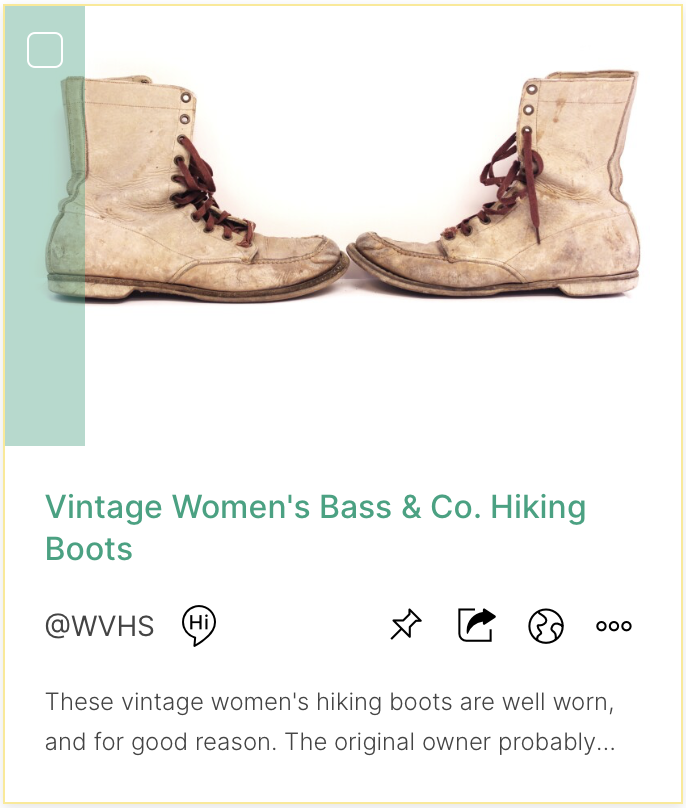
Among the first artifacts added to the Society's collection is a fascinating group of historic footwear donated by longtime resident Jerauld Adams. 


The shoes once belonged to members of the Fabyan and Lorenz families, two families whose stories are intertwined with the early history of Waterville Valley. Even more remarkable, the footwear was discovered inside the home Adams purchased—a house originally occupied by the Fabyan family in the early 1900s and later by the Lorenz family. 

At first glance, these shoes might seem like simple objects from another era. But when paired with their stories, they become tangible connections to the people who helped shape the Valley's history. They invite us to imagine daily life in Waterville Valley generations ago, the challenges residents faced, and the community they built. 


This is exactly the kind of storytelling Artifcts was designed to support. 

Creating a Living Community Archive 

Historical preservation is no longer limited to display cases, filing cabinets, and archival storage rooms. Today's digital tools allow organizations to build living collections that can grow over time, welcoming new contributions and connecting community members through shared stories. 

The Waterville Valley Historical Society's Artifcts collection represents more than a catalog of objects. It is becoming a dynamic archive of local history—one where artifacts, photographs, documents, and memories come together to paint a richer picture of the Valley's past. 


As new items are added, the collection will continue to reveal the people, places, and experiences that have shaped Waterville Valley across generations. 

Explore the Collection 

We are honored to support the Waterville Valley Historical Society as they embark on this exciting new chapter in preserving and sharing local history. 

Their growing Artifcts collection demonstrates how technology and community stewardship can work hand in hand to ensure that meaningful stories are not lost with time. 


We invite you to explore the collection, discover the stories already preserved there, and follow along as new pieces of Waterville Valley history are added in the months ahead. After all, every artifact has a story. Together, we're making sure those stories endure. 

In the greater New England area, or planning a road trip this summer? Stop by the Little Museum at the End of the Road (seriously, the road ends in Waterville Valley) and view the collection in person. 

### 

This collaboration is particularly meaningful for Artifcts co-founder Heather Nickerson, whose connection to Waterville Valley stretches back decades. Having grown up skiing in the Valley and recently returning with her own family, Heather was delighted to support the Historical Society's efforts.  

© 2026 Artifcts, Inc. All Rights Reserved.

Read more
The Great ‘Stuff’ Transfer: Avoid the Clutter and Preserve Your Legacy

The wealth being passed down from Baby Boomers isn’t just dollars — it’s decades’ worth of ‘stuff.’ As we enter what many call the Great Wealth Transfer, the children of Boomers are discovering that a big chunk of what they inherit comes in the form of physical objects: collections, vintage items, and sometimes things nobody quite knows what to do with. 

Our Co-Founder, Heather, discovered this firsthand after losing her mother and having to sort through SO. MUCH. STUFF. 

What’s Actually Being Inherited 

According to a recent Bloomberg article by Chris Rovzar, as much as $90 trillion in assets will change hands over the next few decades. But alongside financial assets lie a mounting inheritance of physical belongings. We're talking about antique furniture, sterling silver flatware, model trains, Hummel figurines, cut-crystal glassware — even miniature pianos. 

Some of these items carry deep sentimental value. For others, not so much. The result? Many heirs feel buried under a mountain of ‘stuff’ they didn’t necessarily ask for. 

Why There's So Much ‘Stuff’ 

Collectors never stopped collecting. Boomers who built their collections over their lifetimes didn’t always see them as clutter. Their passions were real — and they hoped their kids would appreciate them too. 

As we age, many of us may want to downsize. But instead of letting go, we hold on to beloved items or leave the bulk to the next generation. Matt Paxton, star of both Hoarders and Filthy Fortunes, and Advisor to Artifcts sees this daily as he and his team help families downsize and somehow deal with all the ‘stuff.’ 

We are also great at avoiding tough conversations. Not all families talk about what to keep and what to let go of. Without clear plans, decisions fall to the children — who are often under emotional stress. 

The Impact on the Next Generation 

For many Millennials and Gen Xers, dealing with their parents’ estates isn’t just a financial task — it’s deeply emotional work. Rovzar describes cleaning out a parent’s house as “upsetting, stressful and deeply sad,” but also cathartic when you find unexpected treasures like a long-lost recipe or beloved childhood memento. 

On the practical side: 

  • Storage is becoming a challenge. Some families use storage units to hold inherited objects, which can be costly. Self-storage is a $59 BILLION dollar industry in the US alone.  
  • Selling isn’t always easy. Vintage doesn’t always mean valuable. Many items have limited resale markets.
  • Keeping the legacy feels heavy. Not every object has a clear inheritor, and not all heirs want what their parents collected. 

What Can Be Done — Thoughtfully 

Do you find yourself or your loved ones staring at the oncoming ‘stuff’ tsunami and not sure what to do? We asked experts across the organizing, downsizing, and photo management industries on how to navigate this transfer of stuff. They offered up the following advice: 

Have conversations early. Parents and children should talk about what matters, what doesn’t, and what to do with sentimental vs. practical belongings. 

Prioritize what to keep. Not everything needs to survive for another generation. Choosing key heirlooms can help reduce clutter while preserving meaning. Check out our guide to Swedish Death Cleaning to help you purposefully choose which possessions to hold onto and which possessions to rehome or let go of altogether. 


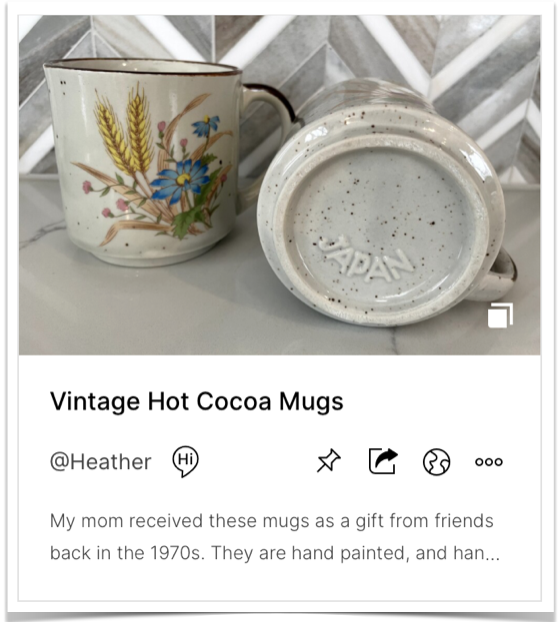
Hot cocoa mugs Our Co-Founder Heather kept these vintage hot cocoa mugs after her mother passed--not for the financial value but because of the memories. 

Be realistic about disposal. Items that don’t hold value may be donated, recycled, or sold. A professional estate sale service can help. Learn more about estate sales and other online options for selling items in our Everything You Need to Know Before Heading to Your First Estate Sale ARTIcles story. 

Document provenance. If a piece has real historical or monetary value, keeping a record helps with future decisions and may make it more meaningful. It can also help your heirs not be “the ones” who accidentally donate a Picasso to Goodwill.  

Why This Matters 

This isn’t just a story about stuff — it’s about generational legacy, memory, and how we value our lives through objects. As wealth moves from one generation to the next, what we inherit isn't just bank accounts; it’s a tangible piece of who our parents and grandparents were. 

For many heirs, sorting through these items is more than a transaction. It’s a way to understand their loved ones, decide what to carry forward, and gently close chapters in a responsible and emotionally respectful way. Matt Paxton shares, "I always tell clients it's not just a chair. It's the person that sat in the chair, and the stories that they told. That's why THAT chair matters."

As you look around your home — or your parents’ if you happen to be heading home for the holidays— notice the items that hold meaning: 

  • The broach worn on a wedding day
  • The tool passed down from a grandfather
  • The ticket stub from a once-in-a-lifetime concert
  • The odd little figurine that always sat on the mantel 

Those keepsakes aren’t just things, they’re experiences, memories, and connections waiting to be captured. Take a moment to Artifct those items, capture the story, the history, and all the little details that make you smile, laugh, or remind you of your loved one(s). Give future generations the context they need — not just the clutter, because the real inheritance isn’t the ‘stuff.’ It’s the life stories and memories behind it. 

Still with us? Extra credit if you use our “In the Future” field to tell your heirs what to do with the item when the time comes — keep, donate, sell, bequeath, or “as you wish.” Lift the weight of uncertainty before it ever lands on their shoulders. 

###

Before you decide what to do with a meaningful item, preserve the story behind it. One photo, a few memories, and the details only you know can help ensure that future generations inherit more than an object, they inherit the context, history, and meaning that made it matter.

Start with one item that tells part of your family's story.

Ready to preserve your own stories? Create a free Artifcts account and begin documenting what matters most.

© 2026 Artifcts, Inc. All Rights Reserved.

Read more
Thousands of Wedding Photos, A Lifetime of Stories

A wedding day flies by in a blur of emotions, laughter, happy tears, and unforgettable moments. Thankfully, cameras are there to capture what memory alone cannot hold. But have you ever wondered just how many photos are taken at the average wedding? 

The answer might surprise you. 

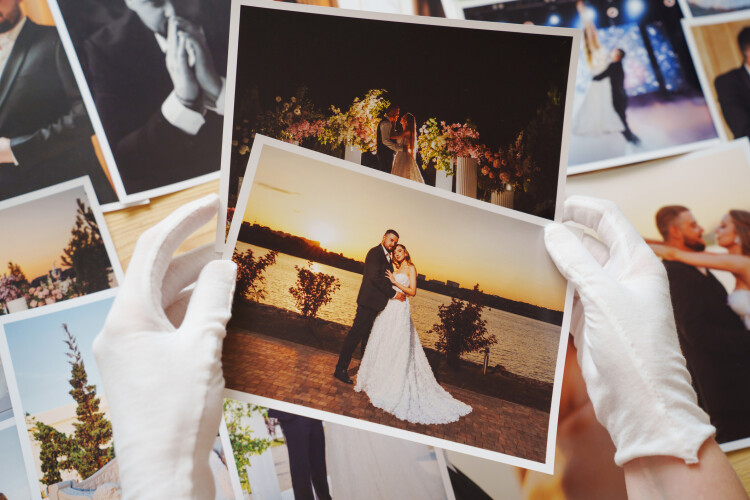
Today's professional wedding photographers typically capture between 2,000 and 4,000 images during a single wedding day, later curating them down to roughly 400 to 800 final edited photographs for the couple. Add in photos from guests' smartphones, photo booths, and second photographers, and a modern wedding can easily generate 4,500 to 7,000 images in total. Yikes! That’s a lot of photos.

With so many images, it's no wonder that wedding photos often end up scattered across hard drives, cloud accounts, albums, social media feeds, and forgotten digital folders. Yet among those thousands of photographs are a handful that become priceless, the images that instantly transport you back to a feeling, a moment, or a story. 

At Artifcts, we call those photos the "Keepers." 

The Photos That Tell the Story 

Years after the cake has been eaten and the flowers have faded, the photos that matter most are often not the perfectly posed portraits. They're the images that capture emotion, personality, and connection. 

Maybe it's the look your partner gave you as you walked down the aisle or your grandmother laughing during the reception. Perhaps it's the flower girl asleep under a table before the last dance, or even Grandpa letting loose on the dance floor. 

These are the images that become family treasures because they tell a story. And that's exactly why preserving the story behind the photo is just as important as preserving the photo itself. 

A wedding photograph without context leaves future generations guessing. Who are these people? Why was this moment meaningful? What happened right before or after the shutter clicked? 

Your wedding photos tell part of the story. Artifcts helps you preserve the rest.

We Asked a Pro: Tips from Photo Archivist Jacqui O'Shea 

To help couples think beyond the traditional wedding album, we reached out to professional Photo Manager Jacqui O'Shea, founder of Magic Lantern Memories. 

As Jacqui explains: 

"Wedding photos are often the first chapter of a new family archive, so I encourage couples and families to think beyond the formal portraits. Preserve the invitation, vows, menu, handwritten notes, candid images, and the quiet in-between moments too. Details big and small help future generations understand not just who was there, but what the day felt like." 

Her advice highlights an important truth: the wedding story isn't limited to photographs of people standing and smiling. The paper invitation tucked away in a drawer, the menu from the reception, the handwritten vows, and the candid snapshots from behind the scenes all contribute to the larger story of the day. 

These supporting pieces can be Artifcted alongside your favorite photographs to create a richer, more complete family archive. 


Bring Your Memories Into Everyday Life 

Wedding keepsakes don't need to stay hidden in boxes, albums, or cloud storage. Jacqui encourages couples to find meaningful ways to enjoy their memories every day: 

"Don't let your wedding photos live only in an album or digital folder. I love helping clients find creative ways to turn favorite images, details, or moments from their wedding day into wall art, collages, or other pieces they can enjoy every day. My husband and I were so in awe of my wedding bouquet that we commissioned a family artist to paint it on a large canvas, which now hangs in our front entryway. Sometimes the most meaningful keepsakes come from the small details that made the day feel like yours." 

A framed photograph, a custom photo book, a shadow box of wedding mementos, or even artwork inspired by a special detail can help keep your memories present and meaningful long after the celebration ends. 

Why Curation Matters 

One challenge many couples face is sheer volume. Hundreds—or even thousands—of photos can feel overwhelming. 

That's why Jacqui recommends a simple but powerful approach: 

"My top tip is to create two collections: a complete archive and a curated story set. The complete archive preserves the full record of the day, while the curated set becomes the foundation for a coffee table book, a slideshow, an anniversary gift, or a family history project. Curation turns hundreds of images into a story you can share and revisit often." 

My top tip is to create two collections: a complete archive and a curated story set.

This advice aligns perfectly with the Artifcts philosophy. Your complete collection preserves everything. Your curated collection preserves meaning. When you identify and Artifct your "Keepers," you're creating a story set that can be enjoyed and understood for generations. 

Don't Forget the Negatives 

For couples married before the digital era, there's another important consideration: preserving original negatives. Many people assume that negatives stored safely in envelopes or boxes will last indefinitely. Unfortunately, that's not always the case. 

Jacqui recently encountered a striking example: 

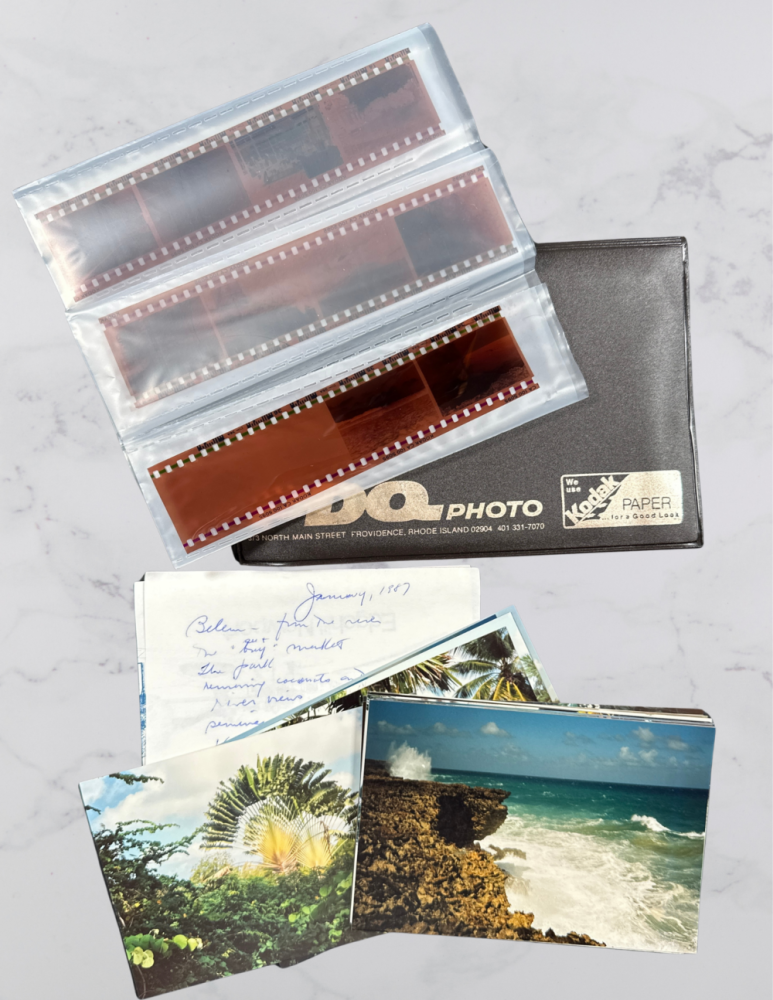
"Don't assume that your wedding negatives are still in good condition simply because they were stored safely after your special day. I recently worked with a client who had hundreds of negatives from her stunning 1988 coastal wedding. Although the negatives were stored in their original envelopes with protective wrapping, chemicals from the developing lab eventually leached onto the film strips, damaging the color chemistry beyond repair (and no printed photos to fall back on). For important negatives, inspect them periodically and consider digitizing them before age, storage conditions, or chemical deterioration makes recovery impossible." 


Consider digitizing negatives to preserve the memories of the day. Image courtesy of Magic Lantern Memories

Whether your wedding took place in 1988, 2008, or last weekend, preserving your photos requires more than simply storing them away. 

Preserve the Photos. Preserve the Story. 

Wedding photos are often the beginning of a family's visual history. They document not only a milestone day but also the people, relationships, traditions, and stories that shape generations to come. 

Among the thousands of images created on a wedding day, a few become the "Keepers"—the photographs that define the experience and carry its meaning forward. Don't leave those stories to chance. 

Artifct your wedding "Keepers" and preserve not only what happened, but why it mattered. Choose the photographs that immediately spark a memory. The ones that make you smile, laugh, cry, or tell a story every time you see them. Add the names of the people in the photo. Share what was happening. Explain why the moment was meaningful. Include details that only you know today.  


Doing so will ensure that years from now, your children and grandchildren won't just inherit images—they'll inherit memories. 

###

Don't Let the Story End with the Photo

Thousands of wedding photos may capture what happened, but the stories behind them are what future generations will treasure most.

Start preserving the memories behind your wedding keepsakes today. Create a free Artifcts account and document the photos, vows, invitations, heirlooms, and moments that made your day uniquely yours.

Create Your Free Artifcts Account

Start with one wedding photo, one keepsake, and one story.

© 2026 Artifcts, Inc. All Rights Reserved.

Read more
A Platinum Band, 21 Diamonds, and a Story Worth Saving

Two weeks before her wedding, our Co-Founder, Heather, found herself unexpectedly in a bind. 

She and her fiancé had carefully designed their wedding bands together. She wanted something simple, a plain platinum band with no embellishments. The design reflected her style perfectly, and she appreciated keeping costs modest. The ring was exactly what she wanted. 

Or so she thought. 

When she returned to pick up the finished rings, she slipped hers onto her finger and immediately felt something wasn't quite right. Sitting beside her engagement ring, the wedding band suddenly seemed too simple. 

The problem wasn't the ring itself. The problem was that she couldn't imagine replacing it. She and her fiancé had designed it together. The ring already carried meaning. 

Fortunately, the jeweler had an idea. What if they added 21 micro diamonds along two-thirds of the band? It would preserve the original design while adding just enough sparkle. The solution felt perfect, especially since her wedding date was on the 21st. 

Today, when she looks at her ring, she doesn't just see platinum and diamonds. She remembers the collaborative design process with her husband, the last-minute panic, and the jeweler's creative solution, and truly can’t imagine a more perfect wedding band. 

That's the thing about wedding rings: the object matters, but the story matters too. 

Wedding and engagement rings are among the most cherished possessions we own. They are symbols of love, commitment, family, and shared history. Yet while we often admire the setting, the craftsmanship, or the precious stones, the most valuable part of a ring may be something you cannot see at all, its story. 

How did the ring come into your life? Who chose it? What sacrifices were made to buy it? Was it passed down through generations? Did it survive a move across continents, a military deployment, or decades of family milestones? 

Years from now, the ring itself may still be sparkling. But unless someone preserves the story behind it, much of what gives it meaning can disappear.  

Every Ring Has a Story Worth Saving 

When people inherit jewelry, they often receive the object but not the context. A granddaughter may know that a ring belonged to her grandmother but never know how it was selected, what it cost relative to the family's circumstances, or why it became such a treasured symbol. 

The story might be: 

These stories transform a piece of jewelry into a family artifact. They connect generations through shared memories and experiences. At Artifcts, we believe preserving those stories is one of the greatest gifts you can leave for future generations. 

The Ring Is Beautiful. The Story Is Priceless. 

Every ring tells a different story. We asked several members of our team about their rings and their stories, and guess what? We learned something new about each of them! It goes to show that even here at Artifcts, a simple question (“What’s the story behind your wedding ring?”) can unlock a new connection, perspective, or even a good laugh.  

Here are a few examples from members of the Artifcts team. 

Heather Nickerson, Co-Founder & CEO 

The story continues! I will fully admit that when I returned to the jeweler to pick up my ring I had another scare. I pulled out my credit card to pay for the ring and paused for a minute (or two), not because of the price, but because that is what I had done in my first marriage which didn’t go so well. I was afraid it would bring bad luck to do the same thing the second time around.  
 
I’m very happy to share that those fears were completely unfounded. Our wedding day was perfect beyond words, and we are still very happily married. And to date, the only time I take my wedding ring off is when I am making meatloaf (his favorite!) or meatballs (my favorite!).  


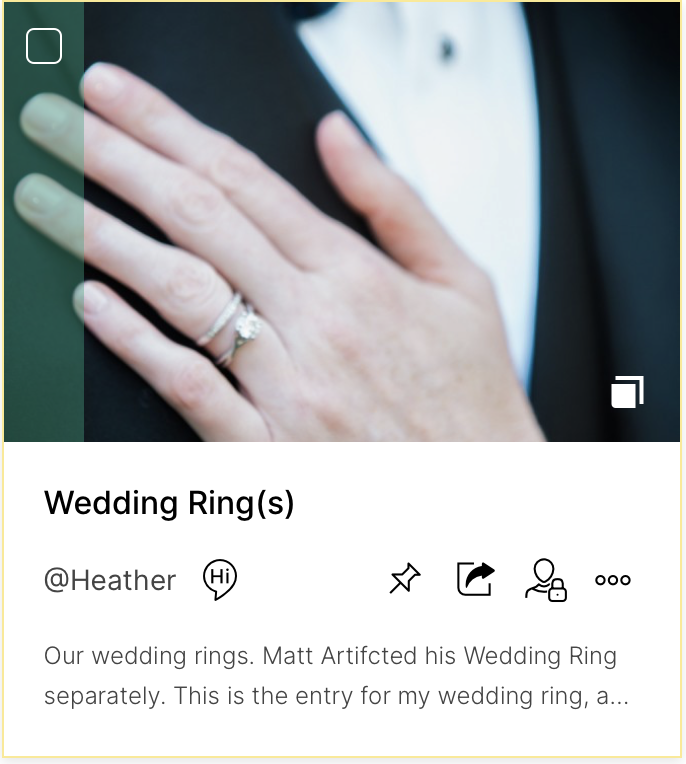
Heather's wedding ring story. Sorry, this Artifcts is private!
Matt Ramsey, CTO 

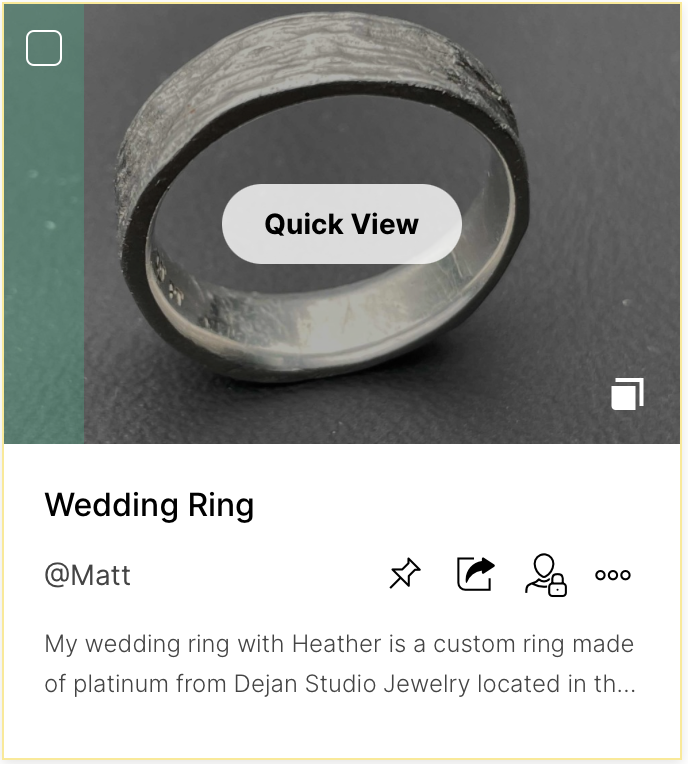
Life can change quickly when you meet the right person, especially when you’re not planning on it and the relationship develops in a way you just know your life needs to head down this path. I realized this under a starry night sky while camping and that if we could put up a tent without arguing, we’d be good for any situation. So, I started searching for the right engagement ring that represented how our relationship was developing and how our lives were to be intertwined. While hiking and resting on a large boulder which I felt represented the solid foundation we’d built our relationship on, I asked and she accepted (maybe out of shock, but the “yes” was set in stone). 

When it came to a wedding band for me, I wanted something with a story, something representative of us. We found a jeweler that did custom rings, and we described who we were (outdoorsy, hikers, etc.) and the proposal story. We started looking at examples of rings with river wash designs that almost looked like water flowing around the ring. The ones he had already designed weren’t perfect for me. So, we took ideas from a couple of designs and he said he would fashion a new one incorporating all the elements of who we were and what grounded us in our relationship. It turned out perfectly and it is simple, unique, and symbolic to who we are as a couple and lifelong partners. 

Now, as I sit on an airplane or have a free moment where I’m fidgeting, I twist the ring around my finger and think of a running stream, mountains, and the fact I found my soulmate. 


Matt's wedding ring and story. Sorry, this Artifct is private! 
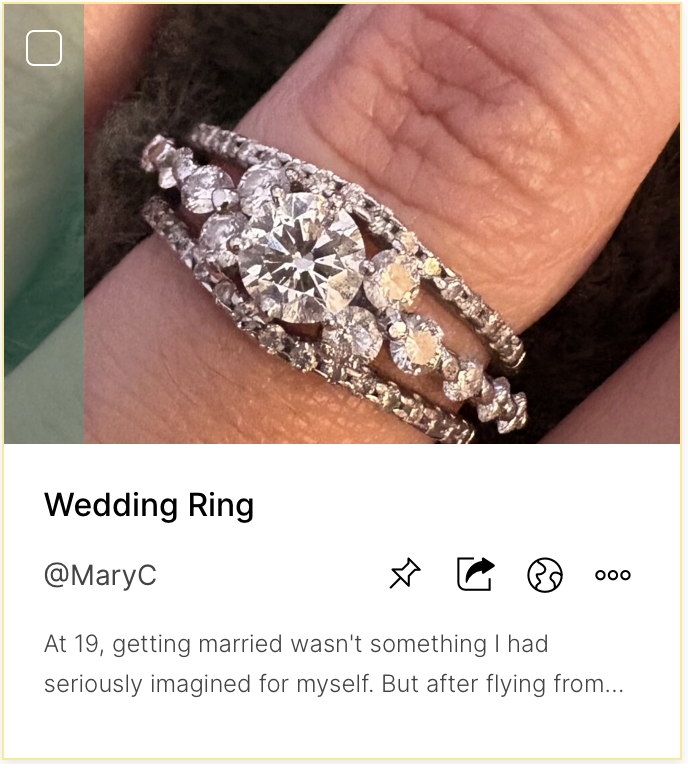
Mary Christian, Director of Marketing & Strategic Partnerships 

At 19, getting married wasn't something I had seriously imagined for myself. But after flying from my hometown of Atlanta to visit my longtime boyfriend in Minot, North Dakota, where he had recently been stationed, I realized my future might be closer than I thought. What began as a visit quickly became a turning point. Standing in a place so different from everything I had known, I could suddenly picture a life that extended beyond the plans I had made for myself and included him in ways I hadn't fully considered before. 

It was December 2007, and Corey (my now husband) proposed to me in Roosevelt Park in front of the statue of Roosevelt himself in the snow. I didn't choose the ring, but when I saw it, I immediately fell in love with it. I think it was more special in my eyes because he picked it himself with the little money he had. I was never afraid to go for what I wanted, and I knew being with Corey was something that I wanted to do, so I said "Yes."  

Showing the ring to my college roommates and friends at Georgia College and State was...to say the least, quite the show! They all couldn't believe that I was choosing marriage at a time most people were choosing parties and beer. I loved my ring and still do. I've never had it updated after almost 18 years of marriage, except it's been through its fair share of sizing changes through pregnancy, weight loss, and hormones. Today, it's still beautiful, and still something that I love and probably won't ever change. It does need another update in size sometime soon. As the last time I travelled, I almost lost it on the plane home! I hope my kids more than anything know that my ring to me represents my freedom to choose what I wanted in life no matter what anyone told me was expected or "right" and that they always have the right to choose their path in life no matter what society says. 


How to Artifct Your Wedding or Engagement Ring 

The beauty of Artifcting a ring is that you are preserving far more than a photograph. You are capturing the memories, context, significance, and value that future generations might never otherwise know. And, if you want to, you can also give your family instructions for what happens next to the ring using our "In the Future" field.  

As you create an Artifct for your ring, consider including photos through the years from your engagement, your wedding day, milestone anniversaries, and even everyday moments where the ring appears naturally. 

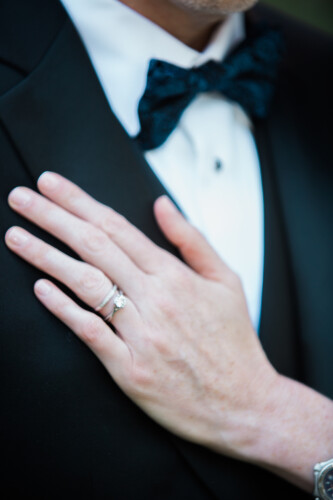
These images help tell a richer story and show how the ring (and maybe even the wearer!) has changed over time. Our co-founder Heather knows that her ring has developed a lot of “character” over the years, as have her hands. The perfectly manicured hands from her wedding day are not the caked in flour, I-just-made-pizza-dough-hands of today.  

As you Artifct your ring, consider recording details such as: 

  • When and where the ring was purchased
  • Who selected it
  • Why this particular design was chosen
  • The proposal story
  • The wedding date and location 

Often the most meaningful details are the most personal: 

  • What did the ring symbolize at that moment in your lives?
  • What challenges or milestones has it witnessed?
  • What do you hope future generations understand about your relationship? 

Consider attaching attached documents and supporting materials such as: 

  • Jewelry appraisals and receipts (great for insurance purposes!)
  • Design sketches
  • Notes, letters, or cards exchanged during the engagement 

These pieces help create a fuller historical record, while also clearly documenting the ring for insurance or estate planning purposes. 

You may also want to consider recording your voice and attaching it to the Artifct as an audio file. One of the most powerful ways to preserve a story is to tell it yourself. Add an audio recording to allow future family members to hear the story in your own words. 

The Ring Is Only Part of the Legacy 

A wedding ring may last for generations. But the stories attached to it are often far more fragile. Without intentional preservation, details fade. Memories become fuzzy. Family members pass away. Eventually, descendants may know they inherited "Grandma's ring" without understanding why it mattered so much. 

When you preserve the story, you preserve the meaning. You ensure that future generations understand not only what the ring is, but what it represented: love, commitment, resilience, family, and the life built around it. 

Artifct Your Ring Today 

If you have a wedding ring, engagement ring, anniversary band, or inherited family ring, don't wait for the story to fade. Take a few minutes to Artifct it today. 

Capture the photographs. Record the memories. Add the documents. Tell the story in your own words. Because one day, someone you love may inherit the ring. And the story you save today could become one of their most treasured family heirlooms. 

### 

Need inspiration for documenting family treasures? Explore our guide on how to Artifct an heirloom and discover simple ways to preserve both the object and the memories that make it meaningful. 

 © 2026 Artifcts, Inc. All Rights Reserved.

Read more
Articles Themes
Contact the Editor
Have feedback? Artifacts to feature? We’d love to hear from you.
Your privacy

This website uses only essential cookies to provide reliable and secure services, streamline your experience, allow you to share content from this website on social media, and to analyze how our Site is used. Learn more about these cookies and cookie settings.

Accept & Continue
Oops! This Web Browser Version is Unsupported

You received this warning because you are using an unsupported browser. Some features of Artifcts will not be available or will be displayed improperly until you update to the latest version or change browsers.

Close
Image for unsupported banner Oops! This Web Browser is Unsupported

You received this warning because you are using an unsupported browser. Some features of Artifcts will not be available or will be displayed improperly until you update to the latest version or change browsers.

Unsupported banner close icon Close