
Give the gift small icon
Give the gift of Artifcts!
HELLO!
Give the gift big icon
Give the gift
of Artifcts

The perfect gift for the person
in your life who has everything.

Give a gift Close

A Family History in Five Artifcts

October 29, 2025

It’s family history month, and if you had to, could you tell your family history in five Artifcts or less? Sound impossible? We weren’t sure, so we decided to put it to the test. 

We reached out to one of our super Artifcters, @Grandmom and asked her, if she had to choose just five Artifcts to tell her story, could she? And if she could, what five would she choose?  

Thankfully, @Grandmom was up for the challenge, although she did preface it by saying “Are you sure, just five? That’s all I get?” Yep, that all you get, at least for this ARTIcles story. “Well, good thing I have my timeline, at least I know where to start!”

Over to you @Grandmom to walk us through your family history, Artifct by Artifct. (The below excerpts are from an interview we did with Grandmom; the words in quotes are direct from the source!)

________________

GRANDMOM'S FAMILY HISTORY IN JUST 5 ARTIFCTS

Artifct #1: The Beginning

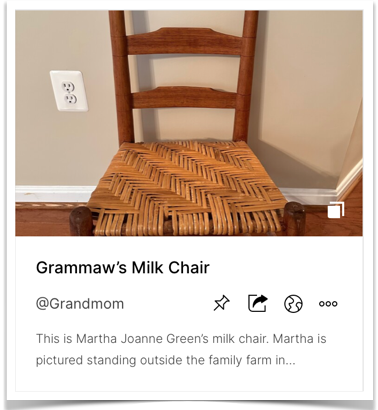
The Milking Chair My Grandfather Built

“Well, I guess I better start at the beginning, sometime in the 1860s. One of my oldest Artifcts is the milking chair my father’s father made his wife. They lived on a farm in southern Georgia. He built it for her because she was so short, that none of the regular chairs were a good fit. He built it right after the Civil War, I don’t think he used a single nail, only pegs. You don’t see that these days.” 


Artifct #2: Childhood in Rural Georgia

Mother's and Grandmother's Wash Boards

Next up? “Well, that would have to be Mother’s and Grandmother’s wash boards. I still have them after all my moves. We grew up in rural Georgia, and we didn’t have much back then, but Mother always made sure we were well dressed and presentable. I still remember her using these boards to do our laundry. I even used them when I was younger! It’s just what you did back then. I can’t imagine what the kids would do today if they had to use washboards. I can tell you; they probably wouldn’t do laundry!”   

Artifct #3: Traveling Far Far Away

Snake Tales

“The next one is one of my favorites—my snakeskin! I still remember [my friend] Shirley’s reaction, ‘I’m not going to do it Martha, you do it, you shoot the snakes!’” What makes the snakeskin so special? “It reminds me of all the crazy adventures and travels that Bobby [my husband] and I had when we were first married. I never could have imagined living overseas, or going on safari, or doing all the crazy things we used to do. I was telling [my granddaughter] about what we did back then, and she didn’t believe me at first. I had to show her the pictures AND the snakeskin. I was something back then!” For the record, we still think you’re something @Grandmom!   

Old photo of a group of people standing around a large dead snake


Artifct #4: Family Time

Our Trusty Station Wagon

“I guess my next Artifct would be our old station wagon, and the photo of the three boys [our sons] in the back. [It's a private Artifct.] Back then we didn’t use seatbelts; I’m not even sure if we had them in the way back! But man, those boys loved that station wagon; Bobby and I did too! We took it everywhere—Brazil, Europe. I still remember I once got a speeding ticket in Rio while driving the station wagon. I had never gotten a ticket before in my life! So many memories. I can still hear Bobby yelling at the boys to quiet down back there or else. The boys remember too!”  

Feeling inspired? Create a new Artifct!

Not a member yet? No problem! Sign up free to start Artifcting.


Artifct #5: Small Momentos of a Life Well Lived

International Spoon Collection

Sounds like travel and all your adventures overseas are a big part of your family history and story @Grandmom? “It was our life back then. We didn’t think twice about it when we were doing it, but it was what our family did. It’s what our boys remember. Living overseas teaches you so much. So, I guess my last Artifct would have to be my spoon collection.

I have one from every place I’ve ever lived or visited! I have at least two hundred! The one spoon I didn’t have until recently was Monrovia. I couldn’t find one when we were living there, but then Joy [my daughter-in-law] found one on Ebay and now my collection is complete! It’s amazing to think that had life been different, we could have stayed in Georgia. I know my boys are thankful we did not do that.” 

Souvenir spoons hanging on a wooden display rack


One of these is not like the other. Is that a spork in the spoon collection?

And there you have it! Five Artifcts; five stories; five memories of a life well lived and well-traveled. If you had to choose, what five objects would you Artifct to tell your story? You can write to us at editor@artifcts.com and let us know, we’d love to hear from you! 

### 

A very special thank you to @Grandmom for sharing her Artifcts and story with us. For those of you curious about this amazing woman, she lived to be 85, had three grown sons, 10 mostly-grown grandchildren, and had lived in six countries and traveled to well over 50. She was married to the “love of her life” for over 40 years and was proud to be her family’s keeper. Why did she Artifct? “To tell the histories and stories behind all my stuff. If I don’t the boys will have no way of knowing what is what.”

We thank @Grandmom's family for letting us reprint this ARTIcle (which originally ran in 2023) as a special tribute to her and the amazing life she lived.

© 2025 Artifcts, Inc. All Rights Reserved.

Share With Friends
5 likes
What's New at Artifcts
Preserving Waterville Valley's History, One Artifct at a Time

At Artifcts, we often say that every object has a story. Whether it's a family heirloom, a piece of artwork, a treasured photograph, or a well-worn pair of hiking boots, the real value lies not only in the item itself but in the memories, people, and history connected to it. 

That's why we're especially excited about our partnership with the Waterville Valley Historical Society, an organization dedicated to preserving and sharing the rich history of one of New Hampshire's most beloved mountain communities. 

A Shared Mission of Preservation 

When members of the Waterville Valley Historical Society (WVHS) first learned about Artifcts, they immediately recognized the potential of the platform to help make their collection more accessible to the community. Historical societies often serve as stewards of remarkable local stories, but finding ways to organize, document, and share those stories in engaging and sustainable ways can be challenging. 

Artifcts offers a different approach—one that preserves not just artifacts, but the stories behind them. As Patty Furgal, President of WVHS said, "Sharing items from the Historical Society's collection with Artifcts was so much easier and faster than attempts at sharing them via adding images and descriptions directly to our website. No technical expertise in website design or graphic design is needed."

By creating digital records that combine photographs, historical details, family memories, and contextual information, Artifcts helps ensure that important pieces of history remain connected to the narratives that give them meaning. Furgal also added, "We can easily create different online ‘exhibits’ using simple tags," such as #WatervilleValley or #FabyanLorenzAdamsCollection

Bringing Local History to Life 

Among the first artifacts added to the Society's collection is a fascinating group of historic footwear donated by longtime resident Jerauld Adams. 


The shoes once belonged to members of the Fabyan and Lorenz families, two families whose stories are intertwined with the early history of Waterville Valley. Even more remarkable, the footwear was discovered inside the home Adams purchased—a house originally occupied by the Fabyan family in the early 1900s and later by the Lorenz family. 

At first glance, these shoes might seem like simple objects from another era. But when paired with their stories, they become tangible connections to the people who helped shape the Valley's history. They invite us to imagine daily life in Waterville Valley generations ago, the challenges residents faced, and the community they built. 


This is exactly the kind of storytelling Artifcts was designed to support. 

Creating a Living Community Archive 

Historical preservation is no longer limited to display cases, filing cabinets, and archival storage rooms. Today's digital tools allow organizations to build living collections that can grow over time, welcoming new contributions and connecting community members through shared stories. 

The Waterville Valley Historical Society's Artifcts collection represents more than a catalog of objects. It is becoming a dynamic archive of local history—one where artifacts, photographs, documents, and memories come together to paint a richer picture of the Valley's past. 


As new items are added, the collection will continue to reveal the people, places, and experiences that have shaped Waterville Valley across generations. 

Explore the Collection 

We are honored to support the Waterville Valley Historical Society as they embark on this exciting new chapter in preserving and sharing local history. 

Their growing Artifcts collection demonstrates how technology and community stewardship can work hand in hand to ensure that meaningful stories are not lost with time. 


We invite you to explore the collection, discover the stories already preserved there, and follow along as new pieces of Waterville Valley history are added in the months ahead. After all, every artifact has a story. Together, we're making sure those stories endure. 

In the greater New England area, or planning a road trip this summer? Stop by the Little Museum at the End of the Road (seriously, the road ends in Waterville Valley) and view the collection in person. 

### 

This collaboration is particularly meaningful for Artifcts co-founder Heather Nickerson, whose connection to Waterville Valley stretches back decades. Having grown up skiing in the Valley and recently returning with her own family, Heather was delighted to support the Historical Society's efforts.  

© 2026 Artifcts, Inc. All Rights Reserved.
Read more
The Great ‘Stuff’ Transfer: Avoid the Clutter and Preserve Your Legacy

The wealth being passed down from Baby Boomers isn’t just dollars — it’s decades’ worth of ‘stuff.’ As we enter what many call the Great Wealth Transfer, the children of Boomers are discovering that a big chunk of what they inherit comes in the form of physical objects: collections, vintage items, and sometimes things nobody quite knows what to do with. 

Our Co-Founder, Heather, discovered this firsthand after losing her mother and having to sort through SO. MUCH. STUFF. 

What’s Actually Being Inherited 

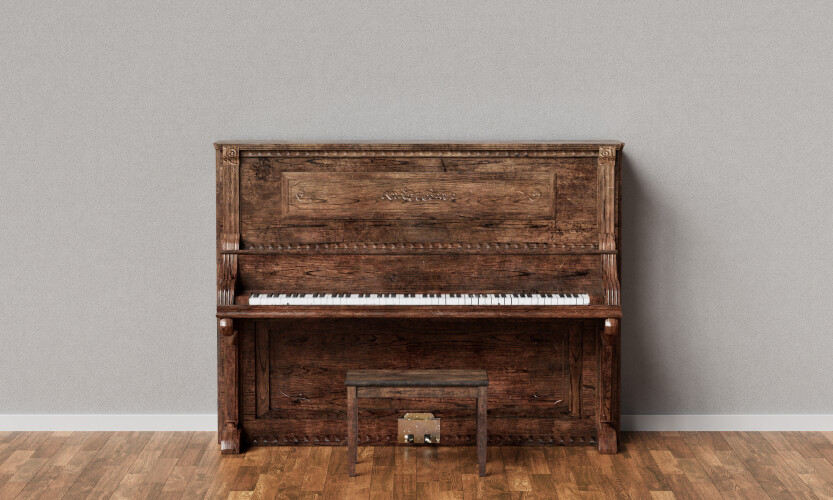
According to a recent Bloomberg article by Chris Rovzar, as much as $90 trillion in assets will change hands over the next few decades. But alongside financial assets lie a mounting inheritance of physical belongings. We're talking about antique furniture, sterling silver flatware, model trains, Hummel figurines, cut-crystal glassware — even miniature pianos. 

Some of these items carry deep sentimental value. For others, not so much. The result? Many heirs feel buried under a mountain of ‘stuff’ they didn’t necessarily ask for. 

Why There's So Much ‘Stuff’ 

Collectors never stopped collecting. Boomers who built their collections over their lifetimes didn’t always see them as clutter. Their passions were real — and they hoped their kids would appreciate them too. 

As we age, many of us may want to downsize. But instead of letting go, we hold on to beloved items or leave the bulk to the next generation. Matt Paxton, star of both Hoarders and Filthy Fortunes, and Advisor to Artifcts sees this daily as he and his team help families downsize and somehow deal with all the ‘stuff.’ 

We are also great at avoiding tough conversations. Not all families talk about what to keep and what to let go of. Without clear plans, decisions fall to the children — who are often under emotional stress. 

The Impact on the Next Generation 

For many Millennials and Gen Xers, dealing with their parents’ estates isn’t just a financial task — it’s deeply emotional work. Rovzar describes cleaning out a parent’s house as “upsetting, stressful and deeply sad,” but also cathartic when you find unexpected treasures like a long-lost recipe or beloved childhood memento. 

On the practical side: 

  • Storage is becoming a challenge. Some families use storage units to hold inherited objects, which can be costly. Self-storage is a $59 BILLION dollar industry in the US alone.  
  • Selling isn’t always easy. Vintage doesn’t always mean valuable. Many items have limited resale markets.
  • Keeping the legacy feels heavy. Not every object has a clear inheritor, and not all heirs want what their parents collected. 

What Can Be Done — Thoughtfully 

Do you find yourself or your loved ones staring at the oncoming ‘stuff’ tsunami and not sure what to do? We asked experts across the organizing, downsizing, and photo management industries on how to navigate this transfer of stuff. They offered up the following advice: 

Have conversations early. Parents and children should talk about what matters, what doesn’t, and what to do with sentimental vs. practical belongings. 

Prioritize what to keep. Not everything needs to survive for another generation. Choosing key heirlooms can help reduce clutter while preserving meaning. Check out our guide to Swedish Death Cleaning to help you purposefully choose which possessions to hold onto and which possessions to rehome or let go of altogether. 


Hot cocoa mugs Our Co-Founder Heather kept these vintage hot cocoa mugs after her mother passed--not for the financial value but because of the memories. 

Be realistic about disposal. Items that don’t hold value may be donated, recycled, or sold. A professional estate sale service can help. Learn more about estate sales and other online options for selling items in our Everything You Need to Know Before Heading to Your First Estate Sale ARTIcles story. 

Document provenance. If a piece has real historical or monetary value, keeping a record helps with future decisions and may make it more meaningful. It can also help your heirs not be “the ones” who accidentally donate a Picasso to Goodwill.  

Why This Matters 

This isn’t just a story about stuff — it’s about generational legacy, memory, and how we value our lives through objects. As wealth moves from one generation to the next, what we inherit isn't just bank accounts; it’s a tangible piece of who our parents and grandparents were. 

For many heirs, sorting through these items is more than a transaction. It’s a way to understand their loved ones, decide what to carry forward, and gently close chapters in a responsible and emotionally respectful way. Matt Paxton shares, "I always tell clients it's not just a chair. It's the person that sat in the chair, and the stories that they told. That's why THAT chair matters."

As you look around your home — or your parents’ if you happen to be heading home for the holidays— notice the items that hold meaning: 

  • The broach worn on a wedding day
  • The tool passed down from a grandfather
  • The ticket stub from a once-in-a-lifetime concert
  • The odd little figurine that always sat on the mantel 

Those keepsakes aren’t just things, they’re experiences, memories, and connections waiting to be captured. Take a moment to Artifct those items, capture the story, the history, and all the little details that make you smile, laugh, or remind you of your loved one(s). Give future generations the context they need — not just the clutter, because the real inheritance isn’t the ‘stuff.’ It’s the life stories and memories behind it. 

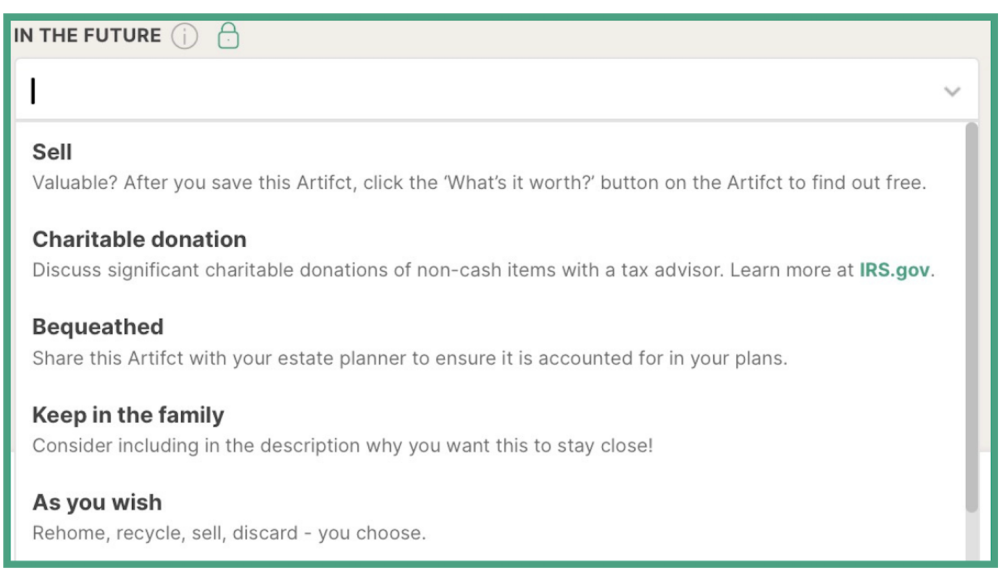
Still with us? Extra credit if you use our “In the Future” field to tell your heirs what to do with the item when the time comes — keep, donate, sell, bequeath, or “as you wish.” Lift the weight of uncertainty before it ever lands on their shoulders. 

###

Before you decide what to do with a meaningful item, preserve the story behind it. One photo, a few memories, and the details only you know can help ensure that future generations inherit more than an object, they inherit the context, history, and meaning that made it matter.

Start with one item that tells part of your family's story.

Ready to preserve your own stories? Create a free Artifcts account and begin documenting what matters most.

© 2026 Artifcts, Inc. All Rights Reserved.
Read more
Thousands of Wedding Photos, A Lifetime of Stories

A wedding day flies by in a blur of emotions, laughter, happy tears, and unforgettable moments. Thankfully, cameras are there to capture what memory alone cannot hold. But have you ever wondered just how many photos are taken at the average wedding? 

The answer might surprise you. 

Today's professional wedding photographers typically capture between 2,000 and 4,000 images during a single wedding day, later curating them down to roughly 400 to 800 final edited photographs for the couple. Add in photos from guests' smartphones, photo booths, and second photographers, and a modern wedding can easily generate 4,500 to 7,000 images in total. Yikes! That’s a lot of photos.

With so many images, it's no wonder that wedding photos often end up scattered across hard drives, cloud accounts, albums, social media feeds, and forgotten digital folders. Yet among those thousands of photographs are a handful that become priceless, the images that instantly transport you back to a feeling, a moment, or a story. 

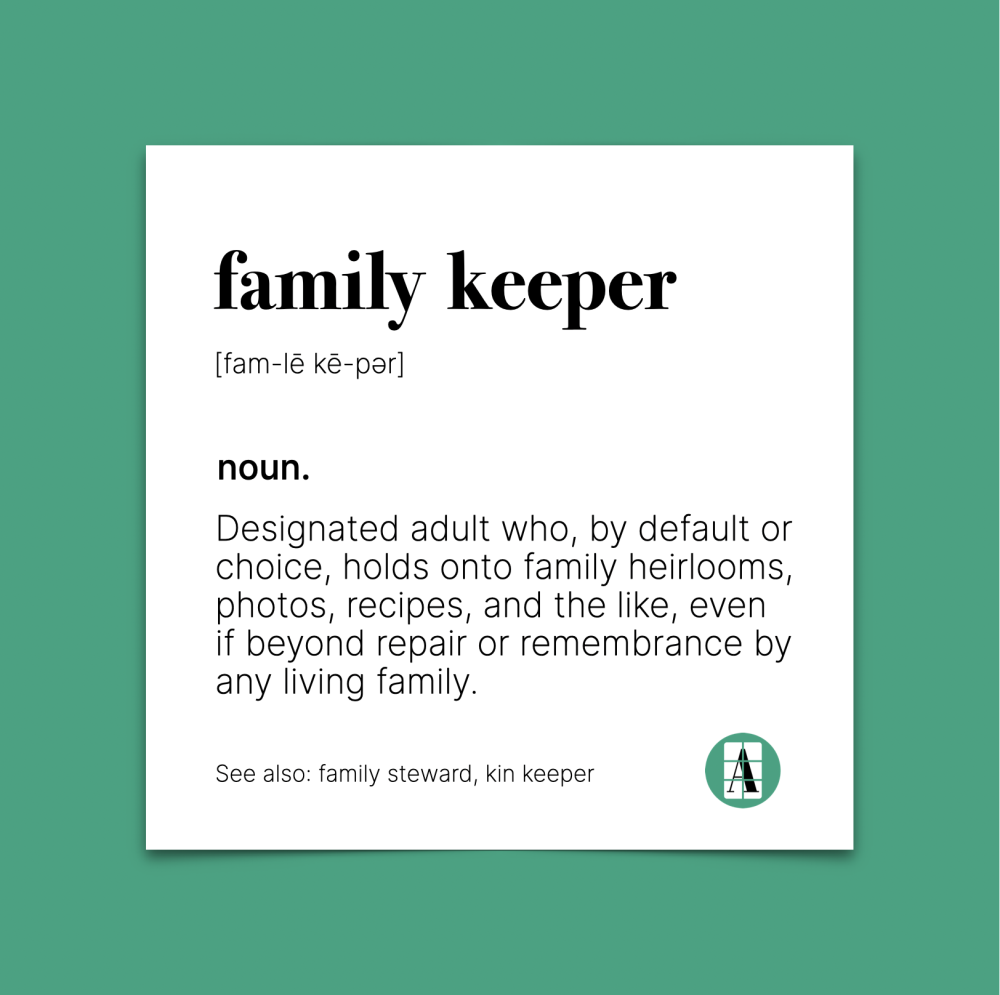
At Artifcts, we call those photos the "Keepers." 

The Photos That Tell the Story 

Years after the cake has been eaten and the flowers have faded, the photos that matter most are often not the perfectly posed portraits. They're the images that capture emotion, personality, and connection. 

Maybe it's the look your partner gave you as you walked down the aisle or your grandmother laughing during the reception. Perhaps it's the flower girl asleep under a table before the last dance, or even Grandpa letting loose on the dance floor. 

These are the images that become family treasures because they tell a story. And that's exactly why preserving the story behind the photo is just as important as preserving the photo itself. 

A wedding photograph without context leaves future generations guessing. Who are these people? Why was this moment meaningful? What happened right before or after the shutter clicked? 

Your wedding photos tell part of the story. Artifcts helps you preserve the rest.

We Asked a Pro: Tips from Photo Archivist Jacqui O'Shea 

To help couples think beyond the traditional wedding album, we reached out to professional Photo Manager Jacqui O'Shea, founder of Magic Lantern Memories. 

As Jacqui explains: 

"Wedding photos are often the first chapter of a new family archive, so I encourage couples and families to think beyond the formal portraits. Preserve the invitation, vows, menu, handwritten notes, candid images, and the quiet in-between moments too. Details big and small help future generations understand not just who was there, but what the day felt like." 

Her advice highlights an important truth: the wedding story isn't limited to photographs of people standing and smiling. The paper invitation tucked away in a drawer, the menu from the reception, the handwritten vows, and the candid snapshots from behind the scenes all contribute to the larger story of the day. 

These supporting pieces can be Artifcted alongside your favorite photographs to create a richer, more complete family archive. 


Bring Your Memories Into Everyday Life 

Wedding keepsakes don't need to stay hidden in boxes, albums, or cloud storage. Jacqui encourages couples to find meaningful ways to enjoy their memories every day: 

"Don't let your wedding photos live only in an album or digital folder. I love helping clients find creative ways to turn favorite images, details, or moments from their wedding day into wall art, collages, or other pieces they can enjoy every day. My husband and I were so in awe of my wedding bouquet that we commissioned a family artist to paint it on a large canvas, which now hangs in our front entryway. Sometimes the most meaningful keepsakes come from the small details that made the day feel like yours." 

A framed photograph, a custom photo book, a shadow box of wedding mementos, or even artwork inspired by a special detail can help keep your memories present and meaningful long after the celebration ends. 

Why Curation Matters 

One challenge many couples face is sheer volume. Hundreds—or even thousands—of photos can feel overwhelming. 

That's why Jacqui recommends a simple but powerful approach: 

"My top tip is to create two collections: a complete archive and a curated story set. The complete archive preserves the full record of the day, while the curated set becomes the foundation for a coffee table book, a slideshow, an anniversary gift, or a family history project. Curation turns hundreds of images into a story you can share and revisit often." 

My top tip is to create two collections: a complete archive and a curated story set.

This advice aligns perfectly with the Artifcts philosophy. Your complete collection preserves everything. Your curated collection preserves meaning. When you identify and Artifct your "Keepers," you're creating a story set that can be enjoyed and understood for generations. 

Don't Forget the Negatives 

For couples married before the digital era, there's another important consideration: preserving original negatives. Many people assume that negatives stored safely in envelopes or boxes will last indefinitely. Unfortunately, that's not always the case. 

Jacqui recently encountered a striking example: 

"Don't assume that your wedding negatives are still in good condition simply because they were stored safely after your special day. I recently worked with a client who had hundreds of negatives from her stunning 1988 coastal wedding. Although the negatives were stored in their original envelopes with protective wrapping, chemicals from the developing lab eventually leached onto the film strips, damaging the color chemistry beyond repair (and no printed photos to fall back on). For important negatives, inspect them periodically and consider digitizing them before age, storage conditions, or chemical deterioration makes recovery impossible." 


Consider digitizing negatives to preserve the memories of the day. Image courtesy of Magic Lantern Memories

Whether your wedding took place in 1988, 2008, or last weekend, preserving your photos requires more than simply storing them away. 

Preserve the Photos. Preserve the Story. 

Wedding photos are often the beginning of a family's visual history. They document not only a milestone day but also the people, relationships, traditions, and stories that shape generations to come. 

Among the thousands of images created on a wedding day, a few become the "Keepers"—the photographs that define the experience and carry its meaning forward. Don't leave those stories to chance. 

Artifct your wedding "Keepers" and preserve not only what happened, but why it mattered. Choose the photographs that immediately spark a memory. The ones that make you smile, laugh, cry, or tell a story every time you see them. Add the names of the people in the photo. Share what was happening. Explain why the moment was meaningful. Include details that only you know today.  


Doing so will ensure that years from now, your children and grandchildren won't just inherit images—they'll inherit memories. 

###

Don't Let the Story End with the Photo

Thousands of wedding photos may capture what happened, but the stories behind them are what future generations will treasure most.

Start preserving the memories behind your wedding keepsakes today. Create a free Artifcts account and document the photos, vows, invitations, heirlooms, and moments that made your day uniquely yours.

Create Your Free Artifcts Account

Start with one wedding photo, one keepsake, and one story.

© 2026 Artifcts, Inc. All Rights Reserved.
Read more
Your privacy

This website uses only essential cookies to provide reliable and secure services, streamline your experience, allow you to share content from this website on social media, and to analyze how our Site is used. Learn more about these cookies and cookie settings.

Accept & Continue
Oops! This Web Browser Version is Unsupported

You received this warning because you are using an unsupported browser. Some features of Artifcts will not be available or will be displayed improperly until you update to the latest version or change browsers.

Close
Image for unsupported banner Oops! This Web Browser is Unsupported

You received this warning because you are using an unsupported browser. Some features of Artifcts will not be available or will be displayed improperly until you update to the latest version or change browsers.

Unsupported banner close icon Close