Give the gift small icon
Give the gift of Artifcts!
HELLO!
Give the gift big icon
Give the gift
of Artifcts

The perfect gift for the person
in your life who has everything.

Give a gift Close

What Will Your Family Remember? A Modern Family Archive for the Modern Family

April 29, 2026

In her recent New York Magazine article titled "What Are We Doing About Our Family Archives?" Kathryn Jezer-Morton raises a question many of us quietly avoid: what are we doing with our family stories, memories, keepsakes, and more?  

It’s the kind of question that quietly follows you into the attic, into the basement, into the moments when you open an old box and find yourself holding something that once meant everything to someone you love. A photograph with no names on the back. A recipe written in a familiar hand. A watch, a letter, a ticket stub—objects that feel heavy not because of what they are, but because of what they carry. 

Most of us don’t think of ourselves as archivists. And yet, in some ways, we all are. 

A body of research shows that family archives—photos, letters, heirlooms, even everyday objects—play a powerful role in how families understand themselves and pass meaning across generations. 

But here’s the challenge: most family archives are fragmented, overwhelming, and at risk of being lost. That’s where Artifcts offers a refreshingly modern approach. 

Your Family Archive, Reimagined 

Family archives are rarely neat or complete. They’re scattered across shelves and drawers, split between relatives, tucked into albums or forgotten in envelopes. And even when we hold onto the objects, the stories behind them begin to soften, blur, and eventually disappear. 

You might know what something is—but not why it mattered. That’s the quiet loss that happens over time. 

Artifcts offers a different way forward. Not by asking you to hold onto more things, but by helping you hold onto what matters most: the stories, the context, the meaning. 

Turning Moments Into Memories That Last 

Using Artifcts feels less like archiving and more like remembering—intentionally. 

When you create an Artifct, you’re not just cataloging an item. You’re pausing long enough to ask: Why is this part of my story? And then you answer it, in your own words, in your own voice. 

It might be an old photograph—one you’ve seen a hundred times but never really documented. You upload it, and suddenly you’re recalling the beach, the summer heat, the way your brother always stood just out of frame until someone insisted he joined. Maybe you don’t know everyone in the picture, but you know enough. And that’s enough to begin. 

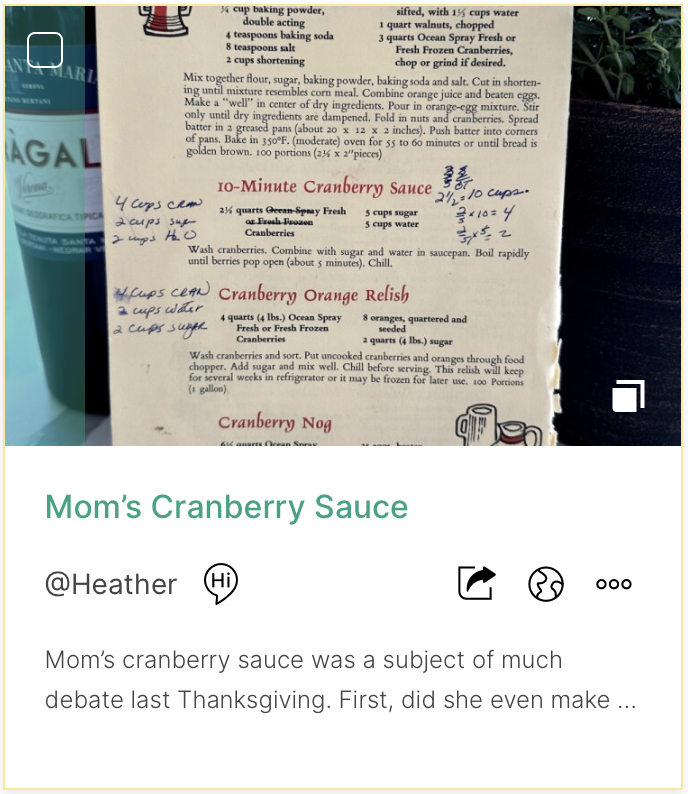
Or maybe it’s a recipe. Not just ingredients and steps, but a ritual. The way the kitchen smelled. The way no one was allowed to sit down until everything was “just right.” You write it down, and then you add something more—a short video, perhaps, of someone in your family making it. Or an audio recording of you explaining why it matters. And don’t forget those “unwritten rules,” Grandma never did. Extra cinnamon, yes please! 


And just like that, something ordinary becomes something lasting. 

Hearing the Past, Seeing the People 

There is something powerful about hearing a voice again; seeing someone’s gestures, their expressions, the way they tell a story only they could tell. Artifcts allows you to add audio and video to your memories, and this changes everything. 

A written story is meaningful—but a spoken one feels alive. 

A written story is meaningful—but a spoken one feels alive. 

Imagine a future grandchild not only reading about a family tradition, but hearing it described in your voice. Seeing the way you smiled when you talked about it. That’s not just preservation. That’s a connection across time. 

Watching Your Story Unfold 

As you begin to add Artifcts, something unexpected happens. The moments start to connect. 

With our Artifcts Timeline feature, your memories are automatically arranged across years, decades, even generations. What once felt like isolated pieces becomes something more like a story unfolding. 

You begin to see patterns. Traditions that repeat. Moves, milestones, turning points. You see how one moment led to another, how a family becomes over time. Your kids and grandkids can see what made you “you.” And the entire family can better understand what matters most to you by the very fact of what you chose to Artifct.  

With Artifcts Timelines, your family archive is no longer just a collection. It’s a narrative pieced together by you over time. 

Letting Go Without Losing Anything 

If you’ve read this far and you’re dreading ending up with a basement full of everyone else’s stuff, fear not. One of the hardest parts of being the keeper of family history is the weight of it all—the responsibility, the volume, the feeling that letting go of something might mean losing it forever.  

Artifcts makes it possible to preserve the meaning of an item even if you decide not to keep the item itself. You can document it fully—its story, its significance, its place in your family—and then choose to pass it on, donate it, or simply let it go. 

What remains is what mattered all along. Not the object, but the memory it carried. 

A Living Archive, Not A Finished One 

Your family archive isn’t something you complete. It’s something you will continue. It grows as you remember more, as you ask questions, as you take the time to capture what might otherwise slip away. It becomes a shared space where stories live—not just for you, but for everyone who comes after you. 

And maybe that’s the real answer to the question Kathryn Jezer-Morton asked. 

We don’t need perfect archives. We don’t need everything organized and complete. We just need to begin. One photo. One recipe. One piece of jewelry. One story. 

Because in the end, it’s not the things we pass down that define us. It’s the meaning we choose to remember—and the care we take to make sure it isn’t forgotten. 

###

© 2026 Artifcts, Inc. All Rights Reserved.
Share With Friends
5 likes
What's New at Artifcts
What Should You Do with Old Cards and Letters?

At Artifcts, we've seen this question come up again and again—and we understand why. 

Today, there are more than 150 publicly Artifcted cards and letters on Artifcts.com, each preserving a story, a relationship, or a moment in time. Our Co-Founder, Heather, has also privately Artifcted more than three dozen cards and letters from her own life (and still has a couple dozen more to go!). 

We hear you, and you are not alone. Cards and letters are sneaky. They don't take up much space individually, but together they can fill boxes, bins, closets, and entire storage shelves. Unlike many other possessions, they're full of sentiment, emotion, and something increasingly rare, handwriting. We want to keep them because they connect us to people and moments that mattered. 


But then life happens. The bins overflow. The storage area fills up. Years pass, sometimes decades. And despite keeping every birthday card, holiday greeting, love note, sympathy card, or handwritten letter, we rarely pull them out to read them again.  

So...what should you do with them? 

Start with a Different Question 

Instead of asking, "Should I keep this card?" ask yourself: 

"What am I really trying to preserve?" 

Most of the time, it's not the paper itself. It's your grandmother's unmistakable cursive. It's the note your child scribbled before they learned to spell. It's the anniversary card that reminds you exactly how you felt in that moment in time. It's the laugh-out-loud birthday card from a friend who always knew how to make you smile. 


Laugh-out-loud and always makes me smile. Mother's Day 2024. Sorry, this Artifct is private!

Often, the physical card is simply the vessel that carries the memory forward, lest we forget. 

You Don't Have to Keep Every Piece of Paper 

Many people feel guilty even considering letting go of cards and letters. It can feel like discarding the relationship itself. But preserving memories doesn't have to mean storing every card, letter, note, or envelope forever. 

As you sort through your collection, consider categories like: 

  • Cards that mark major life milestones.
  • Letters from people who have shaped your life.
  • Notes that tell a meaningful story.
  • Cards with especially memorable handwriting or artwork.
  • Messages that still make you smile, laugh, or cry. 

These are often the pieces worth preserving—not because they're old, but because they continue to have meaning and someday someone else in your family may be curious enough to want to see them or even keep them as part of their family history too. 

Preserve the Memory, Reduce the Clutter 

Whether you're downsizing, helping parents organize decades of keepsakes, or simply reclaiming space at home, preserving the stories first makes it much easier to decide what to do with the physical items afterward. By photographing or scanning meaningful cards and letters and pairing them with your own memories, you create an archive that's easier to revisit than a stack of bins tucked away in the attic. 

Here's an easy way to get started: 

  1. Choose the cards and letters that matter most. Start with a small group—perhaps birthday cards from your parents, letters from a grandparent, love notes, or cards that commemorate major milestones.
  2. Photograph or scan each piece. Capture the front, inside message, back, and envelope if it adds context. Don't worry about perfection; your goal is to preserve the memory.
  3. Add the images to an Artifct and tell the story behind them. Who wrote it? What was happening in your life? Why has this particular note stayed with you all these years? Those details transform a simple card into part of your personal history. 

Once you've preserved both the images and the story, you'll find it much easier to decide whether the physical card belongs in a keepsake box, should be passed on to family, or can finally be recycled.  

Less Clutter. More Memories. 

Cards and letters were never meant to spend decades hidden in storage bins. They were written to be read, remembered, and cherished. That's exactly what Artifcts helps you do. 

Artifct your cards and letters to create a fully accessible, shareable archive of the notes, sweet sentiments, heartfelt messages, and laugh-out-loud moments that matter most. Add the stories behind them, preserve the handwriting, and revisit them anytime, from anywhere. 

Because the goal isn't to keep every piece of paper. It's to keep the memories. Happy Artifcting!

###

Looking for additional tips on how to Artifct cards, letters, and other ephemera? Check out our How to Artifcts Cards & Letters article to help you get started. 

© 2026 Artifcts, Inc. All Rights Reserved.

Read more
The Stories We Didn't Capture | Why Preserving Family Memories Matters

When people ask me why I believe so deeply in what we're building at Artifcts, I could talk about technology. I could talk about digital preservation, AI, or the challenge of organizing a lifetime of memories. But the real answer is much simpler. 

It's my mom. 

Like so many families, as she got older, my brothers and I wanted to preserve her stories. We wanted our kids and grandkids to know not just who she was, but how she lived, what she loved, and why certain objects mattered. 

Through Artifcts, my mom documented more than 200 items, photos, and memories. She photographed treasured keepsakes, family heirlooms, travel souvenirs, and pieces of history that had found their way into our family over the decades. She told stories that otherwise would have disappeared. When she passed away, those Artifcts became one of the greatest gifts she left behind. 


As my brothers and I worked through her belongings, we didn't have to wonder what mattered most to her. We knew. We knew which objects carried special meaning, which family stories deserved to be passed along, and why she had a rather well-preserved eight-foot snakeskin on her bookcase.  

Without Artifcts, so much of that would have been guesswork. And yet...even with more than 200 Artifcts, we discovered something that surprised us. There were still chapters of her life we knew very little about. 

The Stories We Never Thought to Ask About 

Looking back through everything she created, patterns emerged. She documented many wonderful historic family items. She preserved memories from decades of travel and living overseas in such far-flung places as Kathmandu, Rio de Janeiro, and Liberia. She captured objects connected to raising a family overseas and building a life with our dad. 

However, there was remarkably little from her teenage years. Who was she before she became our mother? What were her dreams? What music did she love? What friendships shaped her? What challenges did she overcome before she ever met our father? 

Then we noticed another gap. The last twenty years of her life were barely represented. 

Without a doubt, those years mattered too. They included new friendships, changing priorities, becoming a grandmother to an ever-growing brood of grandchildren, adapting to life's inevitable changes, and countless everyday moments (hello Rummikub champion!) that become precious only after someone is gone.  

Those stories are largely lost to us now. Not because she didn't live them, but because none of us realized they still needed to be captured. We had patted ourselves on the back saying “yep, Gradnmom’s got 200 Artifcts, we’re good,” and, “we’ve heard that story a thousand times, there’s no way we’ll forget it.” Except, somehow, we have. We’ve forgotten the little details and I’m sure mixed-up others. 

Even Hundreds of Stories Leave Room for More 

One of the biggest misconceptions about preserving family history is that it's about finishing an enormous project. It's not. No one ever reaches the point where they've told every meaningful story. 

Life keeps happening. Your story changes every year. The person you are today is different from the person you were ten years ago. The memories that feel ordinary now may become the stories your grandchildren treasure most someday. 

I see this differently now than I did before losing my mom. When someone is still with us, it's easy to assume there will always be another holiday, another phone call, another chance to ask, "Tell me about when..." 

Sometimes there isn't. 

The Objects Matter—Because the Stories Matter 

People often ask whether Artifcts is really about the objects. The objects are important; they're the prompts. A cookbook becomes the story of Sunday dinners. A passport becomes decades of adventure. A baseball glove becomes a childhood friendship. A wedding ring becomes sixty years of marriage. 


Although the objects may anchor our memories, the real treasure isn't always the object itself. It's knowing why it mattered. If I could go back, I'd ask more questions. 

  • I'd ask about the years before I existed. 
  • I'd ask about the years I thought I already understood. 
  • I'd ask about the ordinary days that didn't seem remarkable at the time. 

I can't do that now, but I can encourage others to start today. Take time to document your own story. Take time to capture the stories of the people you love. 

Photograph the objects that matter. Record why they matter. Ask the questions you've been meaning to ask. Preserve the memories that seem obvious today, because one day they won't be. My one closing thought? Leave your loved ones a legacy, not a mystery.  

###

Looking for more inspiration to help you capture your stories? Check out our newest partner, MemoirGhostwriting.com, who has generously discounted their most popular memoir packages for our Artifcts members. 

You may also enjoy reading these additional ARTIcles from our Artifcts vault:

From 'Just Stuff' to Family Gold: The Power of Story

Storytelling Guide for Your Family Heirlooms

The Magic of a Guided Memoir

© 2026 Artifcts, Inc. All Rights Reserved.

Read more
New in Artifcts: Capture the Moment Now, Add the Story Later

You've probably heard the expression, "time waits for no one," and here at Artifcts we know that is true. Whether it's capturing a funny story Grandmom is sharing about her beloved candy jar, or the ten thousandth friendship bracelet woven at summer camp by your pre-teen. The stories and the objects that spark them jump in and out of our lives faster than a summer rain shower.

Sometimes we can capture them on the fly, but other times, why spoil the moment? Here at Artifcts we're excited to announce our new Drafts feature. Drafts allows you to quickly capture what matters—an audio snippet of Grandmom, or a photo of your camper and her collection of bracelets—and fill in the details whenever you're ready.

Drafts allows you to quickly capture what matters...and fill in the details whenever you're ready.

You can share a photo or video straight from your phone's gallery to your Artifcts account to start a new Artifct, or open the Artifcts App and take a photo, record a video, or capture an audio clip on the spot. We've made it easier than ever to Artifct where you're at while not losing sight of what matters most—the small moments, stories, and memories that make us smile. 

How It Works

  • Share a photo or video straight from your phone's gallery to Artifcts to start a new Artifct, or open the Artifcts App and take a photo, record a video, or capture an audio clip on the spot.
  • Add your media, tap Save, then choose Save as Draft. No title, no description, no details required.
  • Your draft appears at the top of your Artifcts list as a Local Draft, stored right on your mobile device.
  • When you're ready, open it back up, fill in the “Name Your Artifct” field and add the “Description or Story” behind it, and do a full Save to push it to the cloud and keep it safe in Artifcts. Once fully saved, you can see and edit it on the Artifcts website.

Our new Drafts feature allows you to capture the moment in seconds and tell the stories on your own time. At Artifcts, your stories matter, and we know your time is precious. Sometimes simply getting THAT photo, video, or audio snippet captured is enough motivation to go back and fill in the details later. 

Feel free to reach out to us at Hello@Artifcts.com if you have any questions or any suggestions for future features. We'd love to hear from you and we value your feedback. 

###

© 2026 Artifcts, Inc. All Rights Reserved.

Read more
Your privacy

This website uses only essential cookies to provide reliable and secure services, streamline your experience, allow you to share content from this website on social media, and to analyze how our Site is used. Learn more about these cookies and cookie settings.

Accept & Continue
Oops! This Web Browser Version is Unsupported

You received this warning because you are using an unsupported browser. Some features of Artifcts will not be available or will be displayed improperly until you update to the latest version or change browsers.

Close
Image for unsupported banner Oops! This Web Browser is Unsupported

You received this warning because you are using an unsupported browser. Some features of Artifcts will not be available or will be displayed improperly until you update to the latest version or change browsers.

Unsupported banner close icon Close